So, I realize that the Platte River itself isn’t necessarily a trail stop (though families certainly would have camped along its banks for a good long while), but it is a big enough feature of the trail that I wanted to spend a post on it.
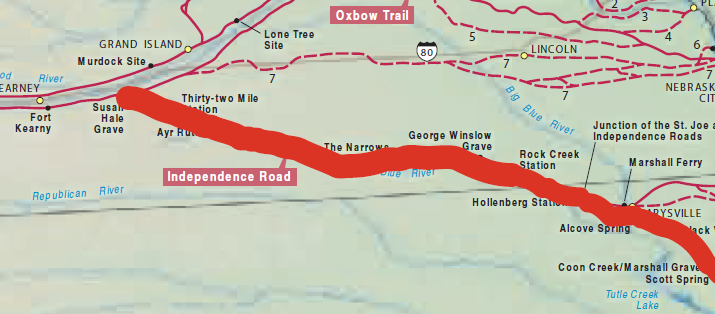
The Platte was somewhere around 90 miles from Rock Creek station, and would take around 5-7 days, depending on pace, exact route, etc. The emigrants traveled up the Little Blue River, hitting places like George Winslow’s grave (died in 1849), The Narrows (an area between the bluffs and river that forced wagons to travel single file.), and Thirty-Two Mile station (likely built in 1859 and named due to being 32 miles from Fort Kearny).
While most of the journey would likely have had ample water, “The trek from the Little Blue to the Platte River—about 50 miles—was the longest distance in Nebraska the Oregon-bound travelers were without water; however, there were far longer stretches between sources of clean water.” (Moulton, “Oregon Trail: Independence, Missouri, to Scotts Bluff, Nebraska.”)
While emigrants typically traveled along the south side of the Platte, at least at first, the route along the Platte river (named The Great Platte River Road) was actually well-traveled in both directions between emigrants and traffic to and from the nearby Fort Kearny.
The Platte river truly defined the prairie. There are various accounts and perspectives, all of which comment on the wide open expanse, with limited trees, but plenty of water. Some found it lovely, others found it lonely. It was here that emigrants saw buffalo and had to collect buffalo chips for fuel. It is also here where belongings really began to be left behind as people lightened their wagons.
“North or south of the Platte, travelers shared similar experiences. Some were delighted by the open, treeless expanse while others were dismayed by it. Many wrote of the flowers, animals, sand hills, and rock formations they encountered along the trail. Nearly everyone complained about the dirty water, the quicksand, and the swarming, biting insects. Most were thrilled by their first sighting of bison and their first taste of buffalo steak, but not so happy about having to collect and cook over “buffalo chips” due to the scarcity of firewood.” (OCTA, “Oregon Trail Mileposts – OCTA.”)
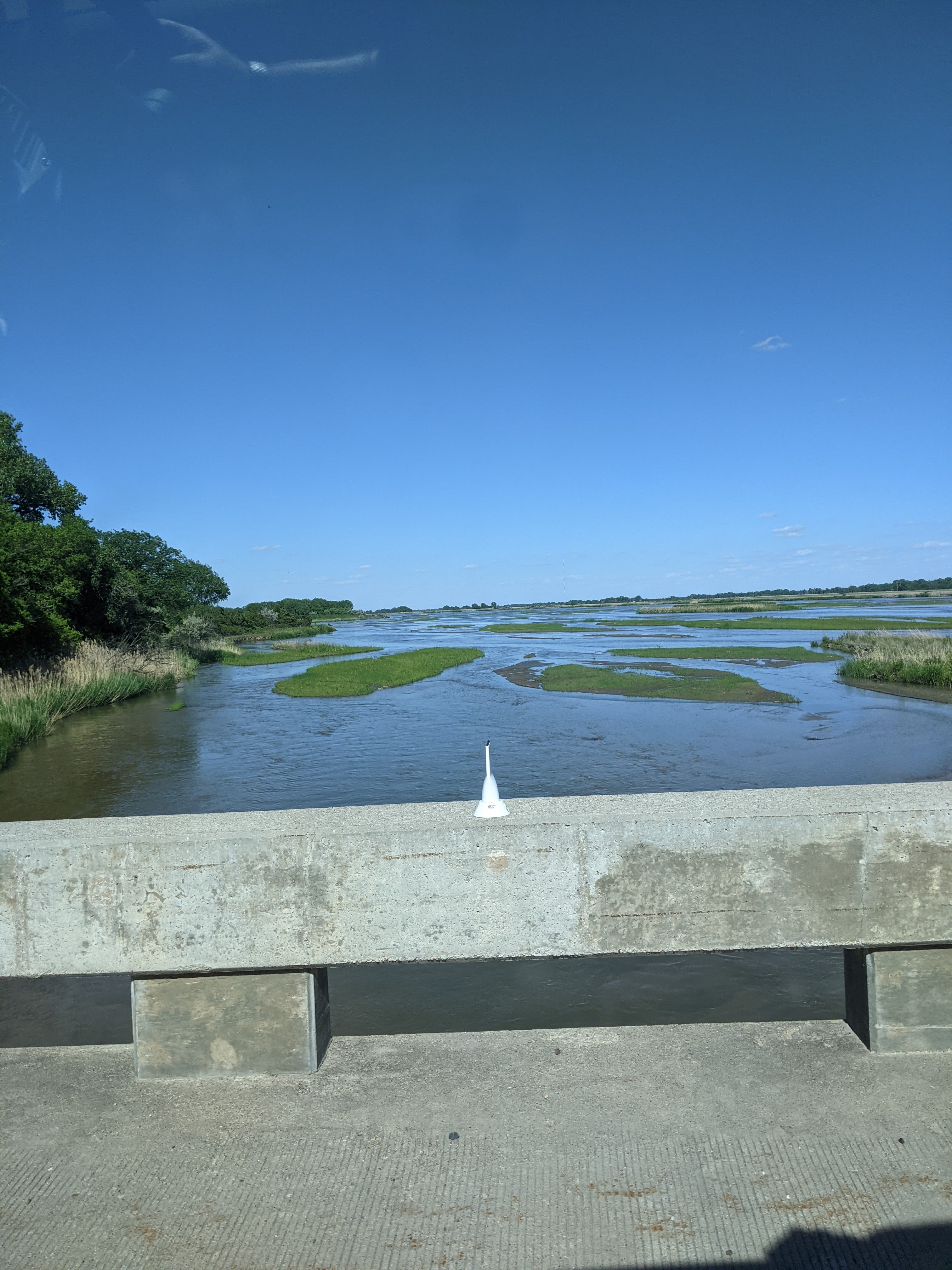
The river itself was broad, about a mile wide, but surprisingly shallow with stagnant pools, lots of channels, and sandbars. I was delighted, when I visited in 2021, to see that the Platte looked exactly how I expected.
We traveled through the most level plains I ever saw in my life. Here is such a scenery of beauty as is seldom witnessed.
—Joseph Williams, circa 1842
Fictional family timeline: April 25th
See below for both partial and full map, and note the highlight indicating how far we traveled! You can also zoom in on the full map for more details (if it works the way it is supposed to anyway…).
Resources:
- Bristow, David. “Crossing the Platte, the Meanest of Rivers.” Nebraska State Historical Society, August 19, 2024. https://history.nebraska.gov/crossing-the-platte-the-meanest-of-rivers/.
- Cramer, Thomas. Cramer’s Journal Containing Incidents of Travel Across the Plains From Kansas to California in 1859, 1859.
- Fanselow, Julie. Traveling the Oregon Trail. Falcon Guides, 1997.
- Littleton, M. Journal of a Trip Across the Plains From Independence, Missouri to California: May 11, 1850 – October 11, 1850, n.d.
- Moulton, Candy. “Oregon Trail: Independence, Missouri, to Scotts Bluff, Nebraska.” True West, November 1, 2002. https://www.truewestmagazine.com/article/oregon-trail-independence-missouri-to-scotts-bluff-nebraska/.
- Murphy, Dan. Oregon Trail: Voyage of Discovery, 1991.
- National Trails System, National Park Service, U.S. Department of the Interior, William Henry Jackson, and National Park Service. “Auto Tour Route Interpretive Guide Nebraska.” National Historic Trails Auto Tour Route Interpretive Guide Nebraska and Northeastern Colorado, August 2006. https://www.nps.gov/cali/planyourvisit/upload/NE_ATR_IG_web.pdf.
- OCTA. “Oregon Trail Mileposts – OCTA.” OCTA, March 29, 2018. https://octa-trails.org/articles/oregon-trail-mileposts/?srsltid=AfmBOoo-Octem5tYU0IWXJX9BELRQBCqy8qs1hlwsQDn9eSS1EOGvTXj.
- ———. “Where Did the Oregon Trail Go? – OCTA.” OCTA, March 29, 2018. https://octa-trails.org/articles/where-did-the-oregon-trail-go/.
- “Platte River Road.” Accessed April 14, 2026. https://nebraskastudies.org/en/1800-1849/routes-west/platte-river-road/.
- “Thirty-Two Mile Station.” Accessed April 14, 2026. https://www.adamshistory.org/index.php?option=com_content&view=article&id=74&Itemid=35.
- “Westward Through Nebraska: [Title:] The Geography of the Oregon Trail in Nebraska.” Accessed April 14, 2026. https://cdrhsites.unl.edu/westward_through_nebraska/KM1933w.8.html#notenKM1933w71.
- “Westward Through Nebraska: [Title:] The Geography of the Oregon Trail in Nebraska.” Accessed April 14, 2026. https://cdrhsites.unl.edu/westward_through_nebraska/KM1933w.7.html.

