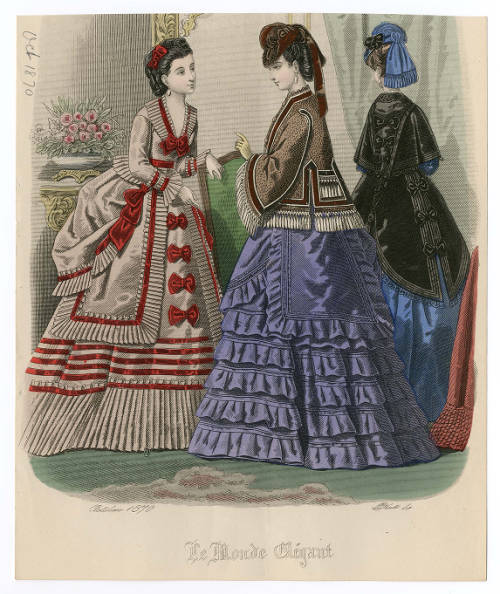
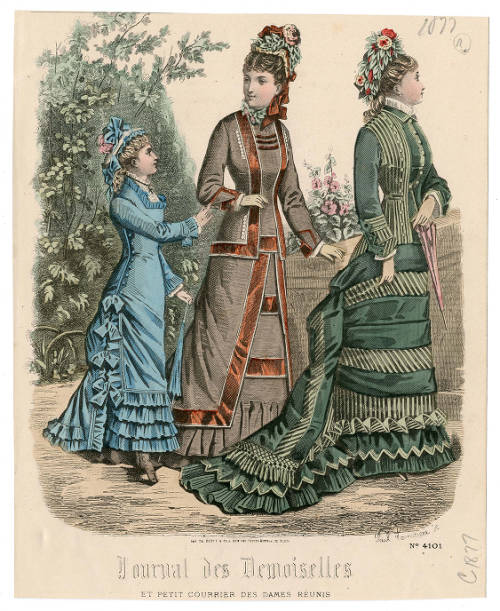
Hats and bonnets galore! Nearly indistinguishable, other than the strings on bonnets. And trimmings were heavy enough to rival the gowns. Enter not only the normal trimmings, but birds as well! According to English Women’s Clothing in the 19th Century “the slaughter of [birds] provided a flourishing industry.” (pg 296). Unfortunately, my resource that went into the most detail about historical fashion, including hats, ends at 1870 so I have less information than in previous posts, much to my sorrow.
Quick Overview
- Both hats and bonnets were generally tilted over the forehead to accommodate the mass of curls that were in style. As the decade wore on, the tilt moved back as hairstyles simplified.
- Bonnets looked just like hats except for the strings that tied under the chin. Hats were secured with elastic under the hair.
- Bonnets and hats were both quite small for the most part, though later in the decade some were a little larger or more fitted than earlier in the decade since the hairstyles were not as complex.
- Both hats and bonnets were heavily trimmed with ribbons, flowers, feathers, and, yes, dead birds. And sometimes veils as well. Often ribbons or lappets hung down from the back.
- Most mentioned materials were felt, velvet, straw, and chip. Morning caps appeared to often be muslin, and the velvet bonnets often seem to be lined with silk.
- Evening styles included small caps, bows, flowers, wreaths, and other accessories to complement hairstyles.
More Details
Here are several examples:
- “Morning cap of a white muslin, trimmed with a row of lace, a black velvet band, and loops of ribbon.” Kunciov, Mr. Godey’s Ladies;: Being a Mosaic of Fashions & Fancies, 160.
- “Cream colored felt bonnet, trimmed with ribbon of the same shade, striped with brown velvet, long spray of different colored flowers and leaves; the same in the face.” Mr. Godey’s Ladies Kunciov, 165.
- Seaside Toilet (1870): ” Hat of Italian straw edged with black blonde and trimmed with velvet flowering in long ends behind. A garland of field flowers is fastened in front and falls over the crown onto the chignon.” (Cunnington, English Women’s Clothing in the Nineteenth Century, 297.)
- Visiting Toilet (1871): “Hat with brim turned up on one side and adorned with tassels, feathers and ribbon.” (Cunnington, 297.)
- Promenade Costume: (1872) “Black velvet hat, the sides turned up and lined by scarlet silk. Trimmed by bows of scarlet ribbon and scarlet feather.” (Cunnington, 298.)
- Walking Dress (1875): “Bonnet of rice straw trimmed with dove colour and lilac ribbons and bouquets of pink geraniums.” (Cunnington, 299.)
- Evening Headdress (1877): “Front hair waved, forms a bandeau over the forehead; at the top of the head a gordian knot of hair. At the back a torsade low on the neck, and a blue aigrette at the side of the head.” (Cunnington, 300.)
- Walking or Visiting Dress (1879): ” Trianon Poke Bonnet in black velvet, tied down over the ears by serge ribbon strings; bouillonne of old gold satin in the hollow brim and raised curtain; loose torsade round crown, and in front a tropical bird on a bed of brilliantly dyed feathers.” (Cunnington, 301.)
Vocabulary
- Chip: Plaited from thin pieces of wood that could be bleached or colored. (Regency World at Candice Hern)
- Aigrette: A spray of feathers or jewels on a hat (Merriam-Webster)
Men’s Hats
Let’s just say men’s fashion changes far less than women’s fashion…the top hat and bowler hat were still popular, the top hat used for more formal occasions or suits and the bowler otherwise.

Resources
- Cunnington, C. Willett. English Women’s Clothing in the Nineteenth Century. Courier Corporation, 2013.
- Franklin, Harper. “1870-1879 | Fashion History Timeline.” Fashion History Timeline. Accessed September 11, 2025. https://fashionhistory.fitnyc.edu/1870-1879/.
- Kunciov, Robert. Mr. Godey’s Ladies;: Being a Mosaic of Fashions & Fancies, 1971. https://www.amazon.com/Mr-Godeys-ladies-fashions-fancies/dp/087861009X.
- Museum, Victoria and Albert. “Print | V&A Explore the Collections.” Victoria and Albert Museum: Explore the Collections. Accessed September 11, 2025. https://collections.vam.ac.uk/item/O607086/fashion-plate/print/?carousel-image=2006AV8492.
- Peacock, John. Costume 1066 To the Present 3e. National Geographic Books, 2006.
- The Metropolitan Museum of Art. “Costume Institute Fashion Plates,” May 19, 2021. https://www.metmuseum.org/art/libraries-and-research-centers/watson-digital-collections/costume-institute-collections/costume-institute-fashion-plates.


“Hats were secured with elastic under the hair.” Lol.
In case this was intended to be serious, note that elastic bands are 20th century inventions. Prior to that, hats were secured with hat pins. Cheap recreations of Victorian hats are secured with elastic under the hair. For any veneer of authenticity, use pins.
Thank you so much for commenting! Yes, I totally understand the confusion. It shocked me to find out that elastic was actually invented in the early 19th century, though widespread use was certainly later. Most notably, Thomas Hancock patented elastic fastenings in 1820 and wrote about it in his book “Personal narrative of the orgin and progress of the caoutchouc or india-rubber manufacture in England” (https://archive.org/details/personalnarrativ00hanc). It particularly began to find popularity after 1860 as it became more reliable, and was used in hats occasionally even earlier than this, although pins were certainly used as well. One of my favorite resources of all time is “Historic Dress in America” by Elisabeth McClellan, written in 1910 about 19th century fashion, and I was honestly surprised at how often elastic is mentioned throughout the book (https://archive.org/details/historicdressin100mccl). Please feel free to let me know if you have any other questions!