Today’s recipe comes from my Harvey House cookbook! Now, I have learned the hard way that not everyone knows who the Harvey Girls are (and if you are one of them, I suppose I forgive you), so allow me a brief explanation.
In essence, Fred Harvey helped civilize the west by establishing good, high quality restaurants along the Santa Fe railroad and employing single girls with high moral standards, thereby contrasting with the typical saloon girls. Okay. I might have gotten that last part from Judy Garland…but I’m pretty sure it’s still true. Anyway. Harvey Houses were established in the 1870s and were renowned for their good food, sweet girls, and beautiful dining rooms.
Now, they did continue all the way into the 1900s, so it is possible that the recipe I chose is technically from the early 1900s, especially since it was one of the ones served on one of their train services, but most likely, its roots are in the 19th century, so I’m still counting it.
Croquettes of Apple
The Harvey House Cookbook by George H. Foster & Peter C. Weiglin
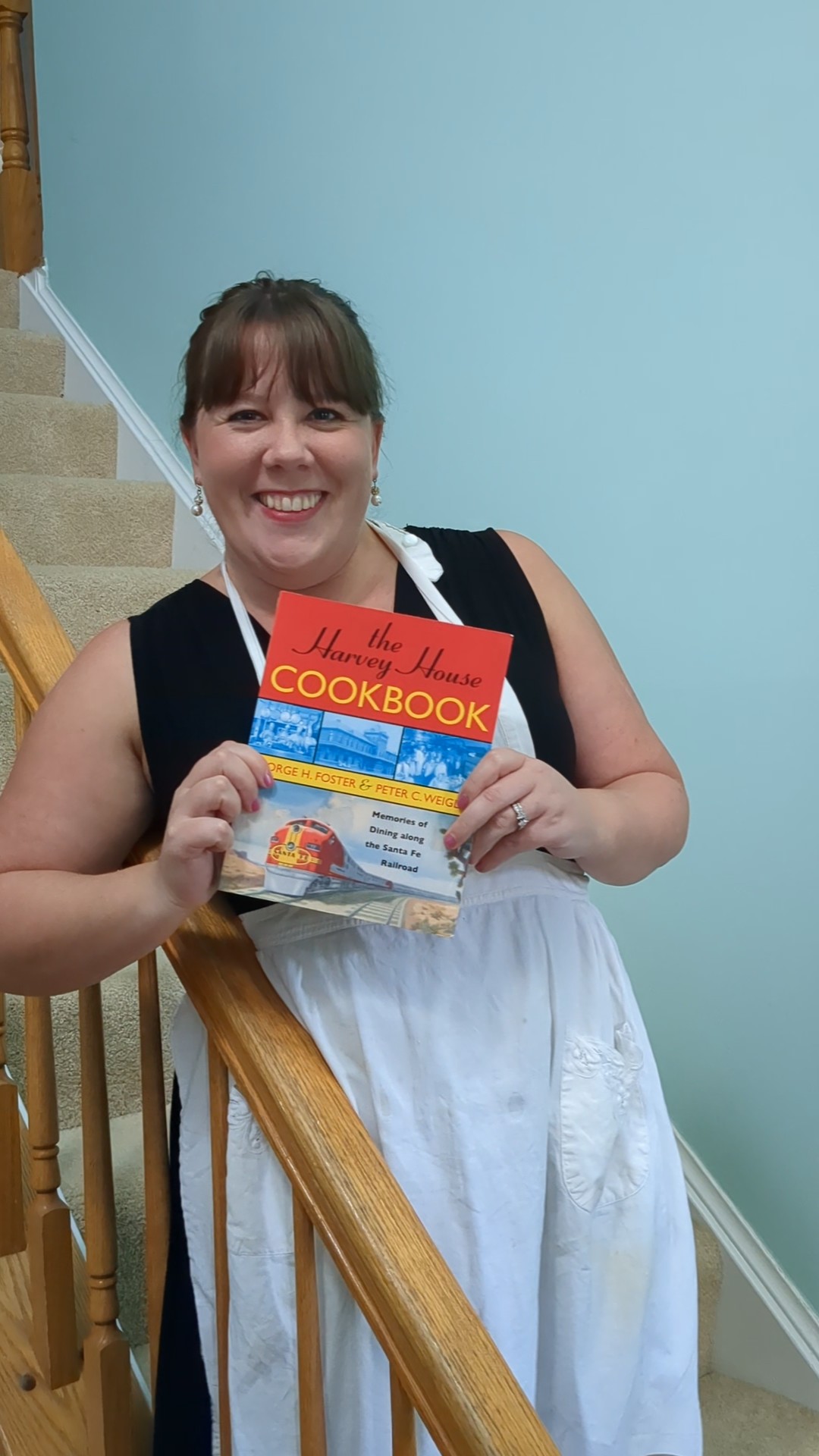

First, I would like to note my black dress and white apron. I know I wear white aprons a lot (I swear, I actually have a ton of colorful ones), but I specifically chose this outfit as a homage to the Harvey Girls, who always wore black dresses with white aprons. See? This is a picture of one in a museum at the Grand Canyon (where, yes, there was a Harvey House! And you can read Kimberley Woodhouse’s Secrets of the Canyon series to hear all about it).
But on to the recipe! The first order of business was to look up what exactly a Croquette of Apple was. I assumed it was an old term for apple croquettes – reasonable, right? And I still think I am right…but apparently this did not transcend time because when I google apple croquettes, a total of one recipe comes up. Well. Two, but the second one is potato croquettes shaped like apples. And the one recipe that does come up is not even remotely like the one in the book and also looks gross, so, despite this specific recipe looking fairly normal-ish, the chances of any of you having had it or anything like it before seems very low! Which, honestly, kind of added to the cool factor of making it.

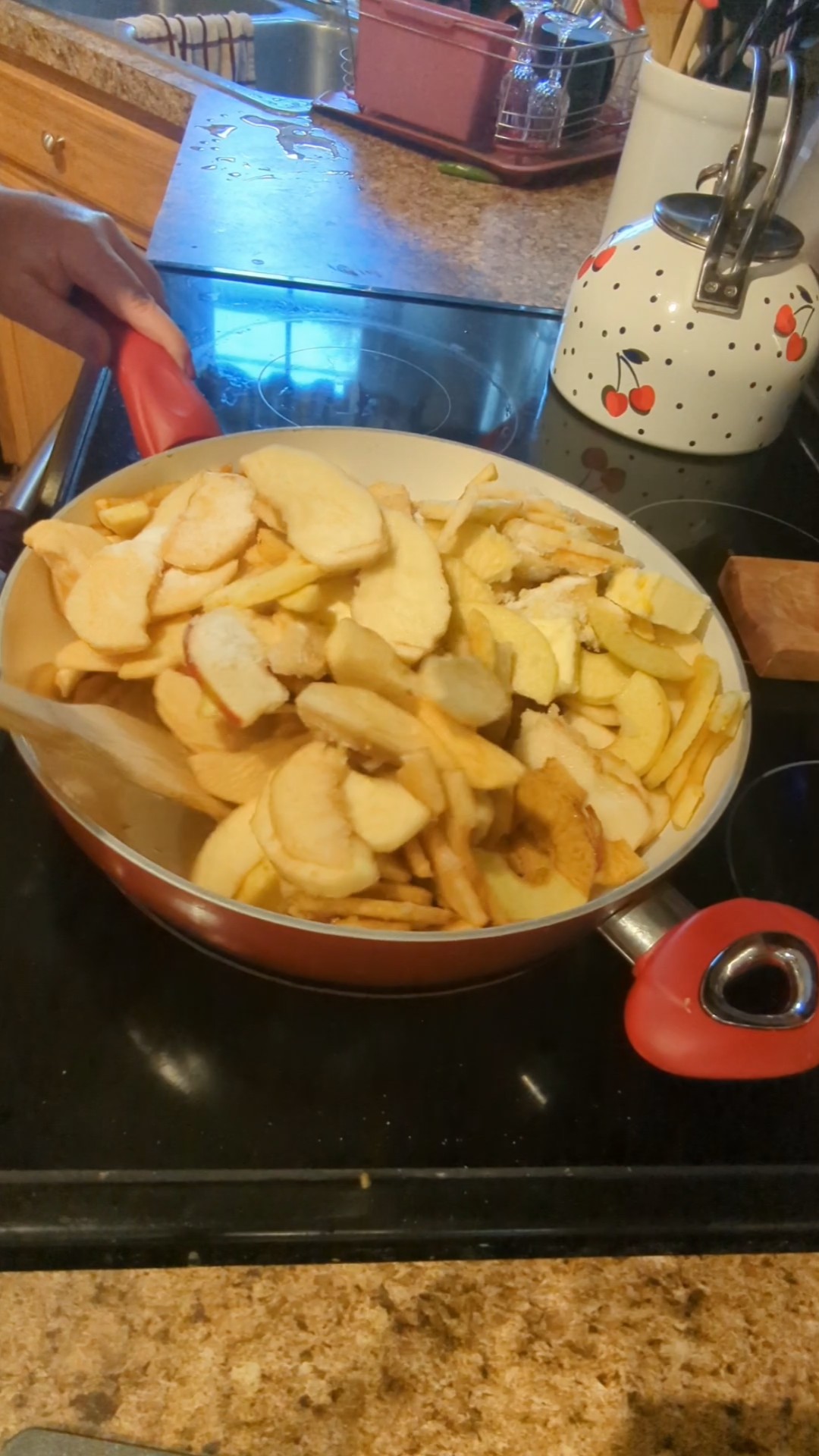
I started, not surprisingly, by peeling, coring, and slicing apples. I was quite excited that I had actually gone to an orchard the weekend before, and therefore had delicious, fresh apples to use! Into a saucepan they went, along with sugar, butter, and lemon rind. My first difficulty came in that the recipe actually used ounces for measurement, so I had to pull out a scale to make sure I actually got it right (yes, I know I can look up conversions online, or do them myself, but I second guess everything, so a scale made me feel better. And, also yes, I did buy a lemon specifically to grate the rind into it. I thought it fascinating that it required only the rind of a lemon and none of the juice.
The next instructions were to “stir on the fire” and reduce until very thick. No indication of how much time this might take. Or what temperature of “fire” to use. For the record, it took long enough that I almost pulled it off early and only through much self discipline did I wait until it was “very thick” which I chose to interpret as no liquid left.

Then add egg yolks and potato starch. I would like you to know that I had to go to a store specifically for potato starch because our local Walmart apparently doesn’t believe in keeping it in stock. I would further like you to know that it came in a large bag. And I used half a tablespoon. Does anyone need potato starch? And I would further, further like you to know that mixing the egg and potato starch into the mixture kind of cooked the yolk and left chunks in it and I was very skeptical.

But wait! Then, the instructions tell me to rub it through a sieve. I considered this for a long time. We all know from previous recipes that a sieve is just a fine mesh strainer. But when they say “rub it through”, do they just mean make sure all the liquid is gone? Or push it around in there to essentially squeeze the liquid out? Or actually rub it through, thereby, making it nothing but mush? I decided on the second easiest route. Just pushing it around with a spoon to extract as much liquid as possible, because I’m sorry, but no matter how soft the apple chunks are, I can’t see pushing them through a fine mesh strainer.

I then spread it out over a cookie sheet – it said to use a dishpan, but since modern dishpans are what we wash dishes in, I chose to believe he meant cookie sheet – to cool and proceeded to the next part.

This part called for pulverized crackers, which led me down an entirely new rabbit trail. What kind of crackers? Club? Ritz? Saltine? Graham (and yes, we know from the Oregon Trail diaries that graham crackers were indeed in existence at this time)? Something else entirely that we don’t have anymore? A search revealed that during the 19th century, the most commonly used cracker was…well…the common cracker. Which, according to at least one source, is kind of like “an oyster cracker on steroids“, but more dry and tasteless. And further searches revealed that I could actually BUY the common cracker from the Vermont Country Story! Alas, it was too late for that now…but next time! So I got oyster crackers. And pulverized them. It was fun.

Once cooled, the apple mixture got turned out onto the pulverized crackers and I was instructed “divide and shape”. Further confusion ensued. First of all, was I supposed to mix the crackers in, or did they serve as some sort of flour–aka, make sure the mixture doesn’t stick to the table? And second of all, how big was I to divide it? What shape? WHY WON’T YOU TELL ME THESE THINGS? I took a cue from the potato croquette recipe online and shaped them into small balls, opting to use the crackers like I would flour – ignoring it. Mostly. I did sometime gather up pieces to make the balls more sturdy–and just in case.
Now it was time to dip them into beaten egg and bread crumbs and fly them “in plenty of hot fat”. I opted for lard, since that seemed the most likely candidate for lots of fat. Did you know that lard smells awful when it is heated up and frying things? Maybe it was just the one I had, but I was nervous about these things – how could that smell not transfer into the taste? Also, it took a LOT of egg. I took the recipe at its word when it called for “beaten egg” and just beat up one egg. My husband had to come to the rescue as I balanced getting more eggs, breading them, and frying them.


And, finally, the apple croquettes were rolled in powdered sugar and ready to be served.

Guys, these apple croquettes were good. Like, sit down and snack on them good. Make them for company good. I could 100% envision these coming out for a desert at a Harvey House – especially made by experienced hands. The world is missing out by letting this recipe fall into the dusty recesses of the attic. We were both surprised, as you can see by Daniel’s face. And subsequent capture of remaining croquettes.


And that’s it for today! Don’t forget to head over to Instagram to see the 45-second version of this recipe!
 Forest Idylls
Yum! I think the modern equivalent to “rubbing through a fine sieve” would be running it through a food mill. In that case, I think you’d end up with something more like apple sauce, and the crackers would help firm it up to hold shape. I think your version probably tastes better tho! 😅
Hmmm…I did think about running it through a food processor or something, but was afraid it would liquify it too much to form actual shapes. But you are probably right about the crackers! Now I’ll have to try it sometime!