Today, I want to talk about shoes. Yes, you may well blink in surprise. Because who, when doing a post on historical fashion, ever concentrates on shoes? Well, exactly! I mean, do you know how hard it is, when you are creating a scene for an historical fiction book, to figure out what shoe they’d be wearing in that situation? I have a sentence in my current WIP that says, “The click of her kid boots echoing through the room only emphasized the hundreds of eyes fastened to her.”
Do you have any idea how many hours of research were poured into that single phrase – her kid boots? And to this day, I scrunch my eyes at it, wondering if I had misread something and she should, in fact, be wearing slippers at the ball. Sigh.
So, yes – shoes are an important aspect of historical fashion, for how little concentration is put on it. In fact, I have an entire book just on shoes! But don’t worry – this time I am keeping it bite-sized for you! Yes, I am dividing by decade, at least for now, so you can look at a glance and not feel like you have to read something super long. We’ll see if I adjust next month so I’m not spending an entire year just on shoes. 🙂
For awareness, since I had to look it up: Vamp = where the top of the shoe ends on your foot
1800-1810ish
Men’s Footwear
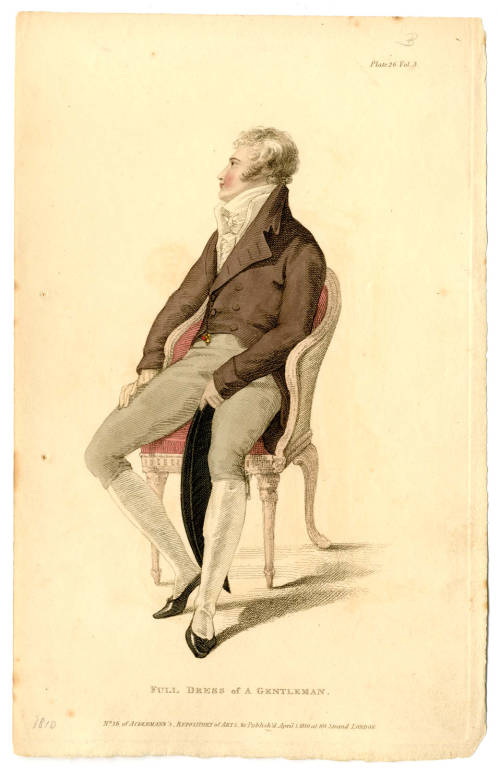
- Generally made of leather, whether boots, pumps, or other
- Low cut vamps, except on boots
- Square toes
- Trimmed with buckles or silk ribbon
- low heels
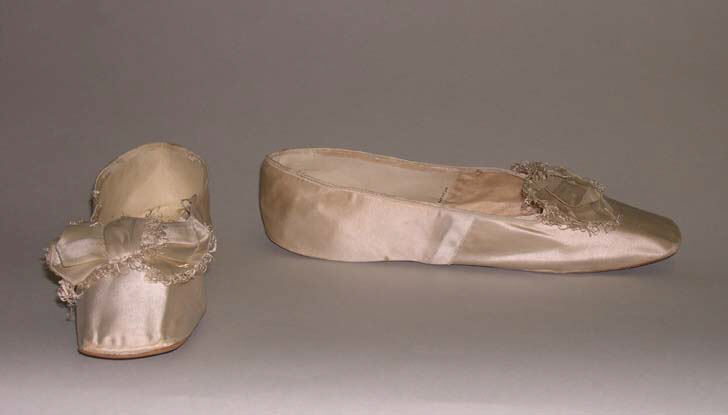
Women’s Footwear
- Flat, with pointed toes, though a small wedge heel was added later
- Very narrow
- Low vamp slippers or half boots
- Materials often black jean, colored velvet, leather, trimmed with bows and ribbons attached at sides
- Evening: Usually white satin with rosettes or chenille trimmings. Earlier in century, trimmings might match the dress trimmings
Resources
- E. Mitchell, Sarah. Northern Ladies Civil War Fashions. Chatham, Virginia, United States: Mitchells Publications, 2013.
- Peacock, John. Shoes: The Complete Sourcebook, 2005. https://doi.org/10.1604/9780500512128.
- Peacock, John. Costume 1066 to the Present 3e: A Complete Guide to English Costume Design and History, 2006. https://doi.org/10.1604/9780500286029.
- Cunnington, C. Willett. English Women’s Clothing in the Nineteenth Century. Mineola, New York, United States: Dover, 1990.
- CONTENTdm. “Men’s Wear 1790-1829, Plate 005,” n.d. https://libmma.contentdm.oclc.org/digital/collection/p15324coll12/id/2442.
- The Metropolitan Museum of Art. “The Metropolitan Museum of Art,” n.d. https://www.metmuseum.org/.
 Forest Idylls
I never gave much thought about historical shoes.
Right? So many people don’t, and yet they also must be accurate in books! 🙂
Sometimes I think about arch support. Since I suffer from plantar fasciitis, I can’t help but wonder if people suffered from it more-so years ago or if shoemakers included arch support in their shoes. Don’t worry – I’m not asking you to find out! Just saying sometimes I wonder about those things.
I doubt there was arch support, though I haven’t looked into it. 😀 They didn’t even have left or right shoes – each shoe was straight, so I can only imagine how uncomfortable these were!
Thanks for the research and references. I am writing a book set in 1811-1815. I learned a new word–vamp and hope I can use it somewhere.
Yes! When I first started doing all this research, I had never heard the term vamp before either, but it is so useful to know! I’m so glad it is helpful.
I am so so so happy to find this! I’m writing something where a girl from the early 1800’s gets fast forwarded in time to modern day New York and she needs new shoes! So I needed to know what she already had and if she would know about sneakers
What a great story!! I am so delighted that this was helpful for you!