Technically, we are now out of the Regency era and not quite to the Victorian era. . . so I guess we just use the overarching Georgian era terminology? While the type of underclothing was essentially the same, the style did start evolving between 1820 and 1840 as skirts widened, the waist shifted, and we moved toward Victorian era clothing, which is radically different from Regency era clothing. Once again, some information in the 20s and 30s might overlap – well, it WILL overlap, but also once again, I’ll do my best to accurately separate them.
Quick Overview
Women:
- Plain chemises
- Silk Drawers
- Fuller Petticoats
- Pantalettes
- Padded and Demi-Corsets
- Bustles
Men:
- Frilled and plain shirts
- Cravats and stocks
- Short and long drawers
- More widespread corsets
Women’s Detail
- Underclothes in general started to become less frilly as people progressed toward more purity/simplicity mindsets, according to Cunnington’s History of Underclothes.
- Chemises were typically made of linen, were unshaped and bulky, and knee-length with a low square neck.
- Petticoats were becoming fuller as fashions moved toward hoopskirts, and as they progressed, sometimes six or seven were worn at a time. Many had an attached bodice with a “stomacher front” and either low round necks decorated with lace or embroidery or necks pulled in by drawstrings. The bodice had no sleeves during the day, and were often made of cotton, while evening petticoats were made of cambric or muslin with short puffed sleeves.
- Drawers (sometimes referred to as “trowsers”) were becoming more widespread, though were still occasionally considered scandalous and were not worn by all women yet. Pantelettes were also occasionally worn.
- Cunnington’s English Women’s Clothing quoted an amusing story from a letter sent in 1820: “[The drawers] are the ugliest things I ever saw; I will never put them on again. . .My finest dimity pair with real swiss lace is quite useless to me for I lost one leg and did not deem it proper to pick it up and so walked off leaving it in the street behind me and the lace had cost six shillings a yard. I saw that mean Mrs. Spring wearing it last week as a tucker. I told her that is was mine and showed her the mate, but she said that she hemmed and made it herself–the bold thing. I hope there will be a short wearing of these horrid pantalets, they are too trying.” The book goes on to say “A similar pair in my collection have the two legs only united by a narrow tape round the waist, which might conceivably give away and lead tot he deplorable catastrophe such as the lady describes.” (Cunnington, 1990, p. 104)
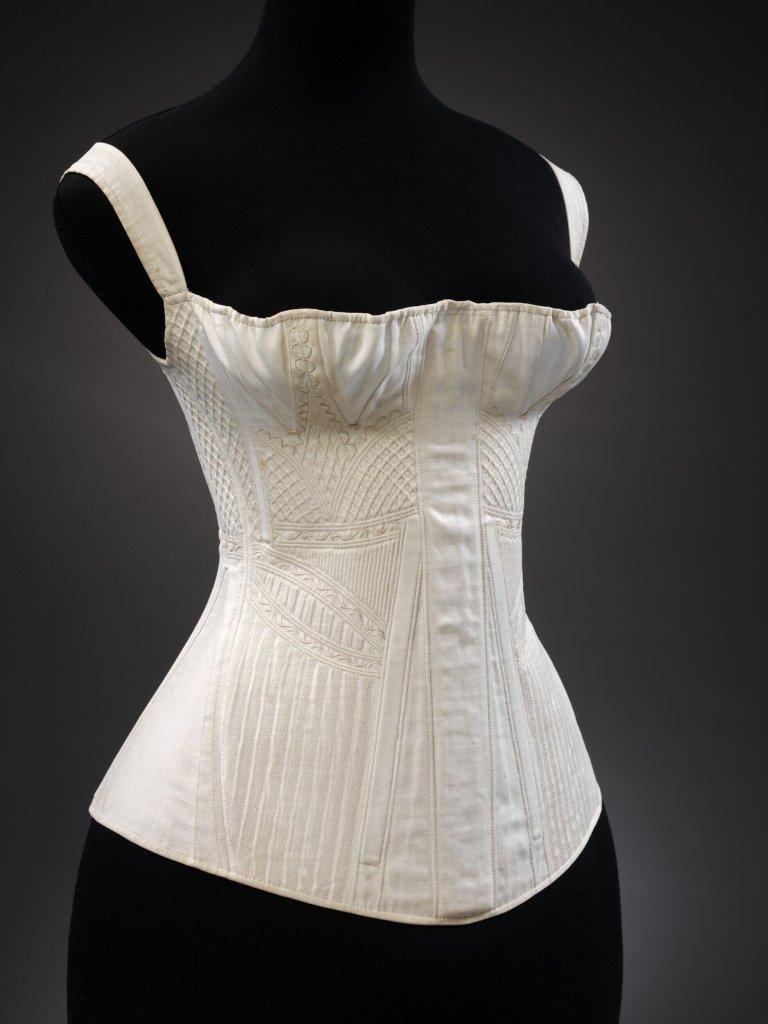
- Corsets were all long now and tight-lacing was coming into vogue and included padding to increase a women’s shape. “Young ladies may be seen with their breasts displaced by being pushed up too high and frightful wrinkles established between the bosom and the shoulders. . . a ridiculous fashion by means of which the body resembles an ant with a slender tube uniting the bust to the haunches which are stuffed out beyond proportion.”(Cunnington & Cunnington, 1951, pp. 131–132)
- By late in the decade, eyelet holes in the corsets were strengthened with metal rings, which helped women tug their corsets ever tighter without ripping them.
- Bustles were slowly becoming larger and were typically stuffed with down.
Men’s Detail
- Shirts were still considered underclothing, since large cravats mostly covered them. However, the frilled front had moved to evening wear only (if one could see it), and the day shirts had tucked fronts. High collars were typically still attached to the shirt and folded down over the cravat, although some detached collars were in use.
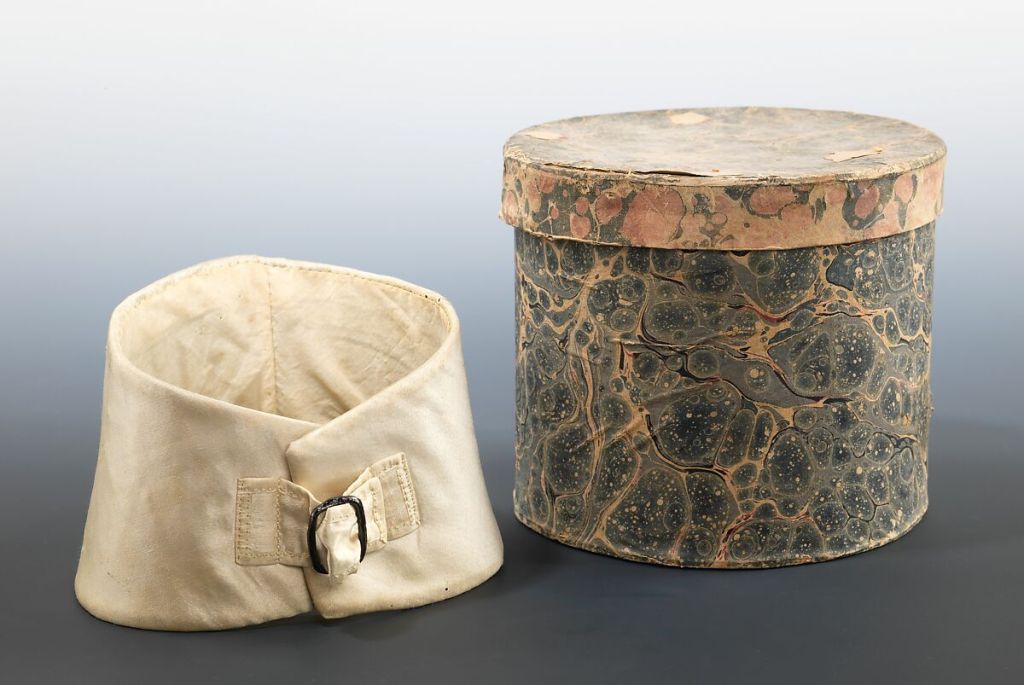
- We’ve already mentioned the cravat, which, as most people know, was a ruffled piece of material tied around the neck. I probably should have mentioned that in the last post – but if you want lots of details on the cravat, take a look at my resources at the end of this post. However, what was new to me was the Stock. A piece of material or a pre-tied cravat that bound tightly around the neck, it was considered more formal and mostly worn by military until this decade, at which time civilians started adopting it as well.
- Drawers were both short and long, with the long being called trouser drawers. Drawers were commonly made of calico, cotton, worsted and China silk.
- Corsets, previously worn mostly by military or dandies, were becoming more widespread and it wasn’t too unusual for fashionable men to wear them. In addition, coats and stockings could be padded to enhance their chests and legs.
Resources
- Cunnington, C. W. (1990). English Women’s Clothing in the Nineteenth Century. Dover.
- Cunnington, C. W., & Cunnington, P. E. (1951). The History of Underclothes.
- Elton. (2016, June 4). Cravats and stocks: Regency Neckwear. Regencygentleman. Retrieved April 8, 2026, from https://regencygentleman.wordpress.com/2016/06/04/cravats-and-stocks-regency-neckwear/
- Fashion in Underwear : Ewing, Elizabeth : Free Download, Borrow, and Streaming : Internet Archive. (1971). Internet Archive. Retrieved January 16, 2026, from https://archive.org/details/fashioninunderwe0000ewin
- Franklin, H. (n.d.). 1820-1829 | Fashion History Timeline. Fashion History Timeline. Retrieved April 8, 2026, from https://fashionhistory.fitnyc.edu/1820-1829/
- Garton, C. (2022, May 18). Shirt points, cravats, and stocks: Men’s fashion of the Regency era. PieceWork. Retrieved April 8, 2026, from https://pieceworkmagazine.com/shirt-points-cravats-and-stocks-mens-fashion-of-the-regency-era
- Kunciov, R. (1971). Mr. Godey’s Ladies: Being a Mosaic of Fashions & Fancies.
- Museum, V. a. A. (n.d.). Corset | Unknown | V&A Explore the collections. Victoria and Albert Museum: Explore the Collections. Retrieved April 8, 2026, from https://collections.vam.ac.uk/item/O138890/corset-unknown/
- Stock – American – The Metropolitan Museum of Art. (n.d.). Retrieved April 8, 2026, from https://www.metmuseum.org/art/collection/search/158752
- Van Brunt, N. K. (n.d.). A Concise History of Underwear From Ancient Times to 1918. Scholarworks @ Morehead State. Retrieved January 16, 2026, from https://scholarworks.moreheadstate.edu/msu_theses_dissertations/567/
 Forest Idylls