We have officially reached the regency era! You’ll find a lot of the items are the same as my last post because, as I mentioned then, the information for styles overlap since many resources lump 1800 – 1830 together, making it difficult to pull apart the nuances. Also, they simply didn’t change that much.
Quick Overview
Women:
- Chemise
- Drawers
- Petticoat
- Pantalettes
- Corsets/Stays
- Bustle
Men:
- Shirts
- Dickey
- Drawers
- Braces
- Corsets
Women’s Detail
- Starting around 1811, the corsets or stays began to shorten again, whereas before, they extended over the hips. Still rigid, they had backlacing and were meant to make the hips small and “bosom shoved up to the chin” (Cunnington and Cunnington 1951, 115). According to Franklin, “During this period, stays more usually referred to stiff, heavily boned structures like those of the eighteenth century, while corsets were a lighter garment with minimal or no boning. However, as corsets supplanted stays, the words were increasingly used interchangeably.” (Franklin n.d.) They were generally made of jean (later known as coutil), dimity, or silk. I will also note that as the decade went on, some sources indicate that the focus became more on making the breasts appear round rather than forcing them up, which the concept of the divorce corset (described below), would support.
- There were two specific corsets of note at this time: The Divorce Corset and The Pregnant Corset. The Divorce Corset contained a panel or piece of iron or steel that sat between the breasts, forcing them apart. The pregnant corset or stay was a longer piece, designed to help pregnant woman look closer to the desired shape (of note: one source says that the pregnant corset was designed to make women look pregnant, but I was unable to find any additional sources to corroborate that claim).
- See my previous post for Chemises and Drawers, with one addition: by 1813, drawers made of knitted cotton with attached feet were being advertised.
- Elastic petticoats were being advertised by 1811 – elastic referring to stretchable materials. The petticoat had a hole on the right side so one could reach a hanging pocket (though with the slim form of the dress, pockets were technically still considered unfashionable). There were often scalloped or trimmed edges and later in the decade, the petticoats had become fuller, if not longer.
- Originally called pantaloons, pantalettes could still occasionally be seen. Cunnington quotes a letter from a Lady Stanley in 1817, ‘”We were insulted by the presence of Lady Charlotte Lindsey in a green silk Spencer, green silk boots, and trousers to the ankle much below the petticoat.’ (i.e., pantalettes).”(Cunnington 114)
- A bustle pad reappeared during this decade – specifically a “sausage-shaped roll” tied around the waist or sewn onto the back of the skirt, designed to exaggerate fullness in the back.
- One more item of note: a far contrast from the slim regency styles, hoops were still worn in court until 1820!
Men’s Detail
- Still considered underclothing due to the waistcoats, neckties, and coats worn over them, shirts had become ruffled at this point.
- See previous post for drawers and braces.
- Corsets were still a thing for men. Cunnington quotes the Diary of a Dandy from 1818 to note some associated difficulties, “Ordered a pair of Cumberland corsets with a whalebone back, a caution to the unwary. The last pair gave way in stooping to pick up Lady B.’s glove.” (Cunnington and Cunnington, 107.)
- Dickeys or false shirt fronts were sometimes worn, particularly in the country.
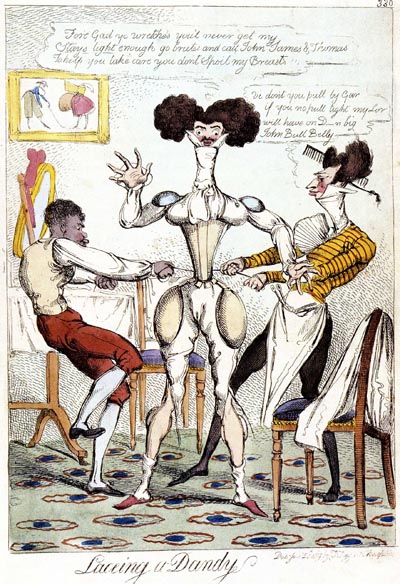
George Cruikshank (artist), Public domain, via Wikimedia Commons
Resources
- Cunnington, C. Willett, and Phillis Emily Cunnington. The History of Underclothes, 1951.
- Franklin, Harper. “1810-1819 | Fashion History Timeline.” Fashion History Timeline. Accessed February 11, 2026. https://fashionhistory.fitnyc.edu/1810-1819/.
- “History of Corsets 1780-1912.” Accessed January 16, 2026. https://silhouettescostumes.com/the-eras-we-build/history-of-corsets-1780-1912/.
- Internet Archive. “Fashion in Underwear : Ewing, Elizabeth : Free Download, Borrow, and Streaming : Internet Archive,” 1971. https://archive.org/details/fashioninunderwe0000ewin.
- McClellan, Elisabeth. Historic Dress in America: 1800-1870, 1910.
- Van Brunt, Nancye Knowles. “A Concise History of Underwear From Ancient Times to 1918.” Scholarworks @ Morehead State. Accessed January 16, 2026. https://scholarworks.moreheadstate.edu/msu_theses_dissertations/567/.
 Forest Idylls