Bonnets continued to be on their way out, considered more the domain of older women, with hats representing emancipation and independence. An article in The Ladies’ Standard Magazine from April 1894 had fascinating things to say about millinery that I did not see elsewhere; a few items have been copied below for interesting reading:
“The latest use for seaweed is to make it up into hats. It is dyed in solid or mixed colors and wrought into flat, round shapes like a plate. These are supple and as tough as felt, and can be turned inside out or outside in, both sides being alike. They are rather heavy looking, but will find great favor with all young people who adopt Tam-O’Shanter headgear, for they are infinitely lighter than felt or wool, and exceedingly original. Decorated with a silk pompon and held in place with a Japanese hat pin, they will very likely adorn the heads of thousands of tennis players and bicyclists during the summer.” (Bryk, American Dress Pattern Catalogs, 1873-1909: Four Complete Reprints, 104.)
“A skimpy looking hat or bonnet is always suggestive of “I-would-if-I-could” affect. If you would be well bonneted, consider these rules: Wear that which is becoming; choose a shape suited to the features; next, a color that adds tone to the complexion; never choose loud or gaudy trimmings.; avoid odd shapes, unless especially becoming, and not to be worn at all times; do not get the latest fad, lest it be worn to death before you can say Jack Robinson; Startling effects may be beautiful for the moment, but the average woman wearies of them; buy nothing but reliable materials; cheap millinery is perishable.” (Bryk, 105–6.)
Quick Overview
- Hat brims were wide, but height was still represented with tall trimmings. Conversely, the toque – a hat without a brim – was also popular.
- Bonnets and hats were usually made with felt, velvet, and fur in winter, with spring bringing forth more of the dainty lace, ribbons, and flowers.
- Ribbon and lace were popular trimmings , along with buckles, feathers, flowers, and, of course, birds.

Examples
- Morning Costume (1890): ” Brown felt toque trimmed with brown velvet and fancy bird; coral pink velvet bow at the back.” (Cunnington, English Women’s Clothing in the Nineteenth Century, 415.)
- Winter Hat (1891): “In black velvet, with garland of small curled ostrich feathers; tuft of feathers at the side.” (Cunnington, 415.)
- (1892): “High crowned hat of fine black straw, with a lace insertion, round brim; pottle crown; fancy green ribbon bows in front and three black plumes at the back.” (Cunnington, 416.)
- April 1894: “The latest novelty is called pearl chip. It is in two shades of green bronze with a red iridescence or reflex. At night it changes to the purple shade called aubergine. This pearl chip is most beautifully woven and will make up into a wondrously stylish hat to go with a tangible silk warp crepon in green bronze and aubergine shades. Another real novelty is chip covered with Cuba bast, giving the effect of changeable chip. It is made up in ruby, emerald, orange, Canary chip and covered with cream or bronze bast; also in combinations, black over red, navy blue over scarlet, black over purple, buff over green, and white over olive.” (Bryk, 104.)
- (1895): “Jet toque with flat crown, trimmed with lemon colored velvet ribbon, looped up with studs, upright feather aigrette on left side, and drooping bunch of yellow flowers on the right.” (Cunnington, 417.)
- Ball Coiffure (1897): ” Victorian style of three step, smooth bows; These can only be made to retain their position and looped appearance by the application of specially prepared pomade.” (Cunnington, 418.)
- (1899): “Red velvet hat, trimmed with red velvet in two shades, twisted together, round crown, finished in front with two velvet loops.” (Cunnington, 419.)
Vocabulary
- aubergine: Color of an eggplant
- Chip: Plaited from thin pieces of wood that could be bleached or colored. (Regency World at Candice Hern)
- Aigrette: A spray of feathers or jewels on a hat (Merriam-Webster)
Men’s Hats
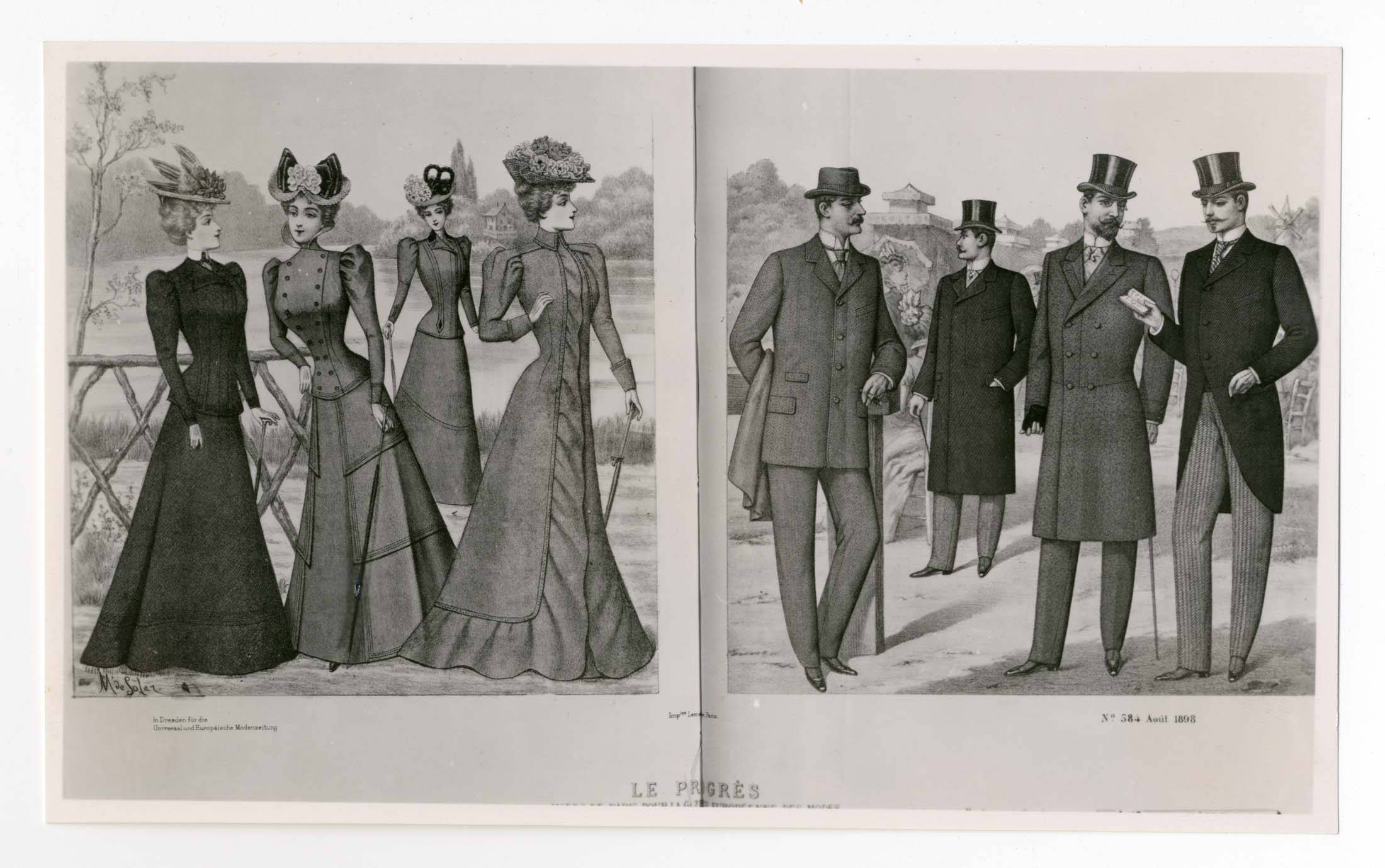
The top hat and bowler were still the most popular choices, though some might also wear a felt hat (derby, bowler, trilby are all mentioned), as well as straw boater hats.
Resources
- Bryk, Nancy Villa. American Dress Pattern Catalogs, 1873-1909: Four Complete Reprints. Courier Corporation, 1988.
- Cunnington, C. Willett. English Women’s Clothing in the Nineteenth Century. Courier Corporation, 2013.
- Franklin, Harper. “1890-1899 | Fashion History Timeline.” Fashion History Timeline. Accessed October 22, 2025. https://fashionhistory.fitnyc.edu/1890-1899/.
- Peacock, John. Costume 1066 To the Present 3e. National Geographic Books, 2006.
- The Metropolitan Museum of Art. “Costume Institute Fashion Plates,” May 19, 2021. https://www.metmuseum.org/art/libraries-and-research-centers/watson-digital-collections/costume-institute-collections/costume-institute-fashion-plates.
- Tierney, Tom. Late Victorian and Edwardian Fashions. Courier Corporation, 2005.
 Forest Idylls
Awesome post. I’m loving not only your research but the way you present it in such an approachable way. Thanks.
Thank you so much! I am so glad you enjoy the posts and it means so much to me that you find them presented well!