‘Tis the season for hats!! Yup, after a couple decades of bonnets being considered superior, the hats once again took over, more and more as the decade passed. Though I suppose we shouldn’t be surprised, considering how small bonnets had become by the end of the ’50s. The Fashion Timeline notes that the main way to tell the difference between hats and bonnets during this time were that bonnets had strings and hats did not, though that seems to be a generalization rather than strict rule.
Quick Overview
- Bonnets, less and less used as the decade went on, were generally flatter and more shallow than in previous years, though still well-trimmed.
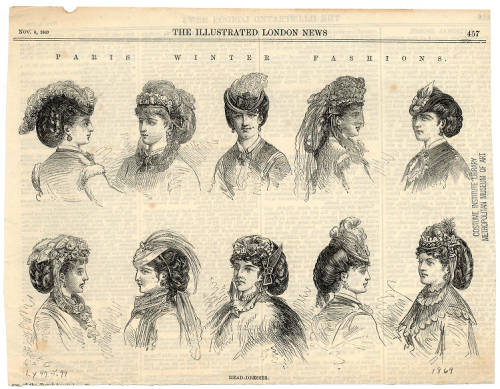
- Hats also got smaller as the decade wore on, starting out at the center of the head and moving more toward being tipped forward by the end of the decade.
- Popular trimmings included flowers, ribbons, lace, feathers, often using a combination of them. There is also occasional mention of back veils and foliage.
- Materials were often velvet and straw, though mentions of silk, lace, felt, and other various fabrics were also made.
- Evening was usually a headdress of some type, made of flowers, ribbon, foliage, etc
More Details
Overall, hats were small and came in a variety of styles. For the most part, they were centered on the head and decorated with a variety of trimmings; most often mentioned were some combination of ribbons, flowers, and feathers. Many were a more round shape, though there were certainly some pointed, and they got more pointed as the decade wore on, as well as tipping over the forehead. Bonnets were smaller and further back on the head than on previous years, and often filled with ornamentations, such as flowers. As the decade wore on though, bonnets began to look a lot like a small hat with strings. Caps were described far less often than previous decades, though still occasionally mentioned, particularly as a home costume. Evening headgear was almost exclusively headdresses of various trimmings, the focus being more on the hairstyle. Trimmings seemed to be a various combination of ribbons, flowers, feathers, and…other things, like ivy or fruit.
Most of the focus in the books are on the actual descriptions of hats and bonnets, likely due to the variety of style, so a better way to represent this decade is likely to give more examples than usual:
- Home Costume (1860): “Headdress of light blue chenille with a ruche of blue ribbon and bows and long ends at the left side, gold buckle in the centre of the bow.” (Cunnington, English Women’s Clothing in the Nineteenth Century, 239.)
- Bonnet of “emerald green velvet with a brim of white bengaline, a full trimming next the face of blond lace, green velvet and white roses, and two sets of strings, one of white ribbon and the other of green velvet.” (McClellan, Historic Dress in America, 1800-1870, 276.)
- (1863) “A wreath of white lilies, violet hyacinths and ribbons twined around branches of wood.” (Blum, Fashions and Costumes from Godey’s Lady’s Book: Including 8 Plates in Full Color, 54.) Likely a description of an evening headdress.
- Ball Dress (1861): Headdress composed of a ruche of black silk with a large rose in the center of forehead; at the back a deep black lace falls onto the neck.” (Cunnington, 239)
- Country Costume (1862): “Sailor hat in crinoline, trimmed with large black feather and small white feather.” (Cunnington, 240.)
- Promenade Costume (1863): ” Hat of white chip with two rows of cerise velvet round the crown, and a large rosette in front to match in colour the trimming of the jacket.”” (Cunnington, 240.)
- “Fine split straw with dark crown, trimmed with a sapphire blue ribbon and a white ribbon. On the right side of the bonnet is a large water-lily with buds and leaves. The inside trimming is a roll of sapphire blue velvet, black tabs, and a small lily on one side.” (McClellan, 277.)
- Home or Promenade Dress (1864): Ecossais hat of ruby velvet trimmed with black ribbon and a tuft of small black feathers. (Cunnington, 241)
- (1864) “A leghorn bonnet trimmed with salmon and black ribbon; black feathers. Bonnet faced with scarlet velvet, black lace and salmon-colored flowers.” (Blum, 66.)
- Ball Dress (1864): “The ornaments of the headdress consist of grapes, vine-leaves and pink ribbon.” (Cunnington, 241)
- Seaside Costume (1866): “Three cornered hat of Leghorn straw trimmed with violet ribbon; in front a jet aigrette, a violet tuft and a white plume.” (Cunnington, 242)
- Walking costume (1869): Tyrolese hat made of fine brown felt trimmed with a velvet band and a velvet cockade at the side, above which a brown feather forms a straight aigrette. (Cunnington, 243)
Vocabulary
- Bengaline: “A very light mohair, self-coloured or brocaded with very small flowers” (Cunnington, 429)
- Mohair: “A fabric made of the hair of the Angora goat, woven with silk, wool, or cotton warps; resembles coarse alpaca.” (Cunnington, 432)
- Chip: Plaited from thin pieces of wood that could be bleached or colored. (Regency World at Candice Hern)
- Leghorn: Tightly woven straw hats (Regency Reader)
- Aigrette: A spray of feathers or jewels on a hat (Merriam-Webster)
- Ecossais: Not super obvious, but pretty sure it is referring to either Scottish or Tartan…feel free to correct me.
- Tyrolese: I believe this references a style of hat found in Tyrol, based on a variety of google search results. It certainly resembles this style of hat.
Random Tidbits
I ran across a few terms in my fashion book that was published in 1910 referencing this decade that were not really mentioned in the other books, which I thought was interesting:
- Braid hat: There were several references to braid hats, which took me some time to figure out since none of my other books reference it, but after much searching, I am fairly certain it simply means hats made of a variety of braided materials.
- “The other [bonnet] is of brown horsehair braid…” ((McClellan, 276.)
- “A Neapolitan braid, grey and white, trimmed with solferino and grey ribbon…” (McClellan, 277.)
- “A Tuscan braid trimmed on one side with white ribbon…” (McClellan, 277.)
- Resources that assisted me in this:
- Mushroom hat: Named for their sloped “mushroom” shape, McClellan claims that the 1907 style is “a revival of a style introduced in 1862”. I am even more fascinated by that, since some sources say it didn’t come in until later than that, such as the Vintage Fashion Guild.
- Jockey Hat: Although not specifically referenced as such in the other fashion books (that I saw), this look was certainly in, especially in the later half of the decade. McClellan’s book even recites a popular song about the Jockey hat! Examples and descriptions are nicely encapsulated in Isabella Alden’s blog post.
- Pork-Pie hat: “not unlike the turban hat in shape, but there was a little space between the brim and crown.” (McClellan, 281.) I have to say, I never would have compared this specific type of hat to a turban…but she isn’t wrong! Great descriptions and pictures from Brixton.
Men’s Hats
The top hat still reigned supreme, but as the decade wore on the bowler hat showed more and more prominence, and even a straw hat or two may have made an appearance. John Peacock mentions top hats with wide bands, shallow bowlers, and bowler hats with curled brims. The Fashion Timeline says, “…as the decade wore on, the top hat became increasingly formal and began to be reserved for only the frock, morning and tailcoat (Shrimpton 35). The rounded bowler hat was more frequently seen with sack jackets and flat-crowned straws were worn in summer….”


Resources
- Blum, Stella. Fashions and Costumes from Godey’s Lady’s Book: Including 8 Plates in Full Color. Courier Corporation, 1985.
- Cunnington, C. Willett. English Women’s Clothing in the Nineteenth Century. Courier Corporation, 2013.
- Franklin, Harper. “1860-1869 | Fashion History Timeline.” Fashion History Timeline. Accessed June 21, 2025. https://fashionhistory.fitnyc.edu/1860-1869/.
- McClellan, Elisabeth. Historic Dress in America, 1800-1870, 1910.
- Peacock, John. Costume 1066 To the Present 3e. National Geographic Books, 2006.
- Sun, Ming-Ju. Godey’s Fashions. Courier Corporation, 2005.
- The Metropolitan Museum of Art. “Costume Institute Fashion Plates,” May 19, 2021. https://www.metmuseum.org/art/libraries-and-research-centers/watson-digital-collections/costume-institute-collections/costume-institute-fashion-plates.
 Forest Idylls