While the style of hats and bonnets did change somewhat in this decade, it seems to have been a fairly slight change, especially compared to many previous decades – though that could be because all the fashion books are so concentrated on the change in actual dress (enter the hoopskirt/crinoline and first introduction to the bloomers). Overall, it looks like the majority of the change came in the form of pushing the brim of the bonnet back so that one could actually see around it. The Fashion History Timeline describes the change as, “Bonnets, defined as a hat tied with strings under the chin, remained the vastly dominant choice of millinery, but they changed subtly from the inhibiting style of the previous decade. Brims shortened away from a woman’s face, and it was worn further back on the head, exposing more hair.” (Franklin, “1850-1859 | Fashion History Timeline.”) Once I delved into details, I would say that it also looks like more traditional hats were coming in by the end of the decade, with wider brims and ribbons. There also appear to be a lot more headdresses and cap-like bonnets/hats than previously.
Quick Overview
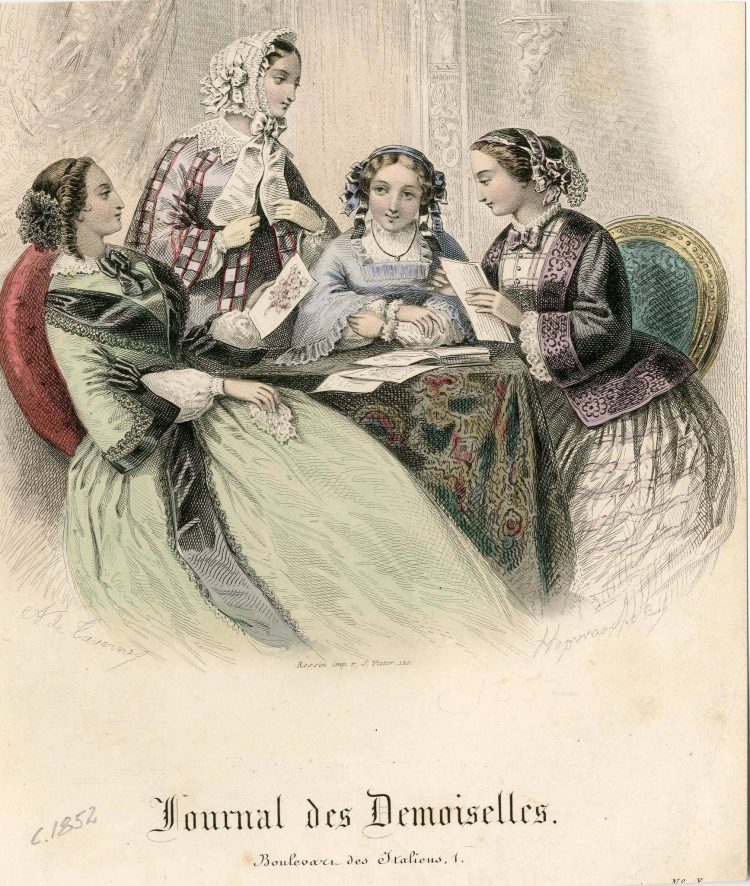
- Bonnets, hats, and caps, most worn further back on the head with wider brims. The bonnets (and caps) were often called out as very small.
- Popular trimmings were often ribbons and flowers, but still some lace and feathers as well.
- Materials might be felt, velvet, straw, satin, and tulle (though tulle was often used as part of the trimming instead).
- Evening was often flowers, a wreath, or a headdress trimmed of ribbons and feathers.
More Details
- Bonnets: Often Drawn or leghorn, similar to the previous decade. While the crowns are low and further back on the head, it is not unusual to have elaborate trimmings on the inside of the bonnet, such as flowers, ribbons, tulle, and even fruit is mentioned. As the decade drew on, it appears the bonnets grew smaller and smaller, with colorful, long ribbons. As the decade drew on, hats began to make a reappearance, with larger brims and ribbons to tie them.
- Caps: Often worn either during the day or evening, they copied the bonnet by shrinking and being worn further back on the head, though as the decade progressed they appear to have been worn less and less. Often made of lace, tulle, and ribbon, they could also be covered in flowers.
- Evening: Caps were not unusual in the early part of the decade, but as in the previous decade flowers, wreaths, and similar ornaments seem to be more popular.
Below are a variety of examples from Cunnington’s book:
- Morning Dress (1851): “Cap of white lace, trimmed round the back part with four rows of narrow white lace, finished on each side with a bow and ends of pink ribbon, with loops on each side of the face.” (Cunnington, English Women’s Clothing in the Nineteenth Century, 197.)
- Promenade Costume (1853): “Bonnet of fancy straw trimmed with black velvet; on the left side. Forward on the front are placed three poppies and two more at the bottom of the crown above the curtain; inside is a cap of blonde with loops of black velvet and small poppies.” (Cunnington, 198.)
- Evening Costume (1857): “Headdress of pink ribbon forming fanchon, long ends left floating at the back; trimmed with a fringe and has a rose at each side.” (Cunnington, 200.)
- Carriage Costume (1858): ” Bonnet of white and pink velours èpinglè, ornamented with white blonde and feathers; tulle cap with tresse of roses; strings of white velvet with pink stripe at the edge.” (Cunnington, 201.)
- Seaside Costume (1859): “Mousquetaire hat of brown straw with wreath of poppies and wildflowers; black lace falling around the edge.” (Cunnington, 201.)
Men’s Hats
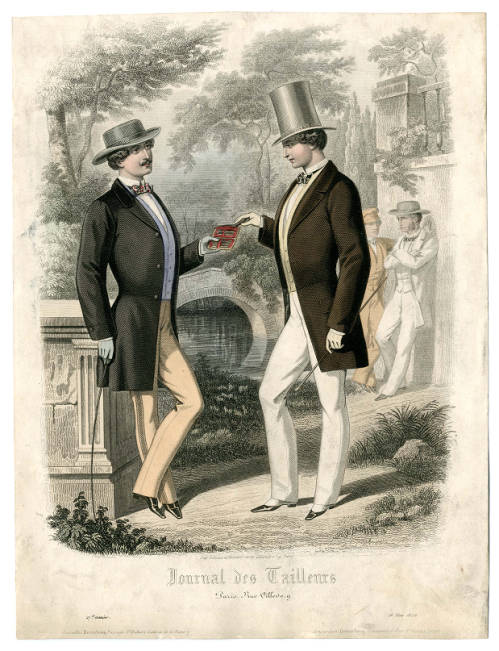
While tall-crowned top hats were still quite popular, a couple other hats finally made their way onto the scene in this decade. Specifically, the bowler hat! Made of either soft or hard felt, it could be used instead of the top hat during the day. According to the Fashion History Timeline, in the country, a man might also wear the “wide awake hat, a low-crowned, wide-brimmed felt.” (Franklin.)

Resources
- Cunnington, C. Willett. English Women’s Clothing in the Nineteenth Century. Courier Corporation, 2013.
- Franklin, Harper. “1850-1859 | Fashion History Timeline.” Fashion History Timeline. Accessed March 28, 2025. https://fashionhistory.fitnyc.edu/1850-1859/.
- McClellan, Elisabeth. Historic Dress in America, 1800-1870, 1910.
- Peacock, John. Costume 1066 To the Present 3e. National Geographic Books, 2006.
- The Metropolitan Museum of Art. “Costume Institute Fashion Plates,” May 19, 2021. https://www.metmuseum.org/art/libraries-and-research-centers/watson-digital-collections/costume-institute-collections/costume-institute-fashion-plates.
 Forest Idylls