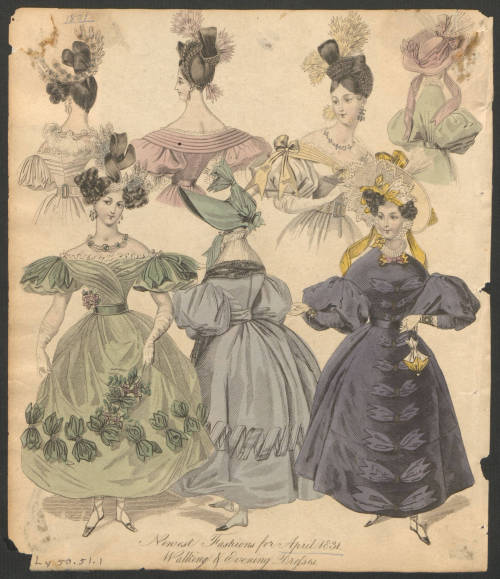
This decade started out as the last one ended – with extravagant, large hats, overloaded with trim. But, by the end of the decade, hats followed the style of dress and significantly toned down, becoming slimmer, more unassuming, and sedate (at least by comparison). Cunnington said of the 1830s, “The novice may have some difficulty in distinguishing a hat from a bonnet as shown in contemporary fashion-lates and may even be led to suppose that the terms were almost synonymous. In reality the distinction was carefully observed; the hat always had a brim of sorts at the back, even when it was concealed (as it often was toward the close of the decade) by a curtain or bavolet.” (Cunnington, English Women’s Clothing in the Nineteenth Century, 122.)
Quick Overview

- Bonnets and hats were the rage of the day, with day caps still worn at home.
- The exact shape of the bonnets and hats changed as the decade wore on, moving from quite large to small; near the middle of the decade, hats were large and bonnets were small.
- Popular trimmings included ribbons and flowers. Feathers were still popular in the beginning of the decade, then seemed to be less so.
- Materials varied by season; leghorn, rice straw, velvet, silk, and satin were all often used.
- Young women wore braided hair with ornamentation in the evening, while married women favored hats and turbans.
More Details
- Bonnets: Bonnets were typically used for the carriage or promenade. Trimmed in ribbons, feathers, and flowers, earlier in the decade, the brim might be square and wide, but by the end of the decade was very close fitting, with low crowns and closed brims. The Drawn bonnet and cottage bonnets were both popular, and the back was usually curtained to prevent the neck from sunburning. The Bibi, or English Cottage, bonnet was used broadly, even as the brims grew smaller and more circular. McClellan mentions that, at least at the beginning, both hats and bonnets were still “of the Cabriolet shape” (McClellan, Historic Dress in America, 1800-1870, 183.), which she earlier informed us was a shape named after a fashionable carriage. (McClellan, 177.) (On a personal note, I find it interesting that this source, published in 1910, references the Cabriolet bonnet more than once, but I have yet to run into the reference anywhere else. I’d love to know if any of you have heard it elsewhere). By the end of the decade, bonnets had deep brims and were very long at the sides. The flowers and ribbons weren’t quite as overwhelming and were often sewn to the inside of the bonnet. Veils started to come into play near the end of the decade, and a bonnet might be worn with one. While feathers were still used extravagantly in the beginning of the decade, by the end, bonnets were usually only trimmed with one or two. Almost universally, bonnets were trimmed with ribbon and tied under the chin.
- Example: “The Capote Anglaise. Also known as ‘bibi’ or ‘English cottage bonnet’. The crown, of drawn material, is round and placed rather far back; the brim, often of drawn material also, is of moderate size, cut square at the corners and low at the ears, but open across the forehead; simply trimmed with a ribbon knot on the side of the crown and perhaps one feather. Lined with satin and often a curtain or ‘bavolet’ of blond or silk.” (Cunnington, 124.)
- Hats (with some additional bonnet references): Hats were typically used for walking or promenade (and some in the evening – see Evening section). Day hats, as mentioned in the overview, were similar to the shape of the bonnet especially near the end of the decade. Both hats and bonnets started out with an oval shape and then became more circular. As hats and bonnets became smaller, linings on the inside were used, made of silk, satin, gauze, or velvet. Interestingly, Cunnington mentions that in the middle years, the hats were large and the bonnets were small, but McClellan quotes a source in 1835 as saying that both bonnets and hats were enormously big in 1835. This may be explained by The Fashion Timeline, which says that it wasn’t until 1836 that the hat and bonnet size dropped off. Early in the decade, hats typically had wide brims and were short at the ears, tied with ribbon, but slowly becoming more bonnet shaped. They were often made of leghorn, silk, and rice straw (particularly popular in the summer, as a more affordable option). You might also start seeing lace veils worn with walking dresses. The capote shape quickly became popular, sometimes with demi-veils, and, as the decade wore on, curtains were usually attached to the back. Hats were often tied under the chin by ribbon, but sometimes left loose. Both hats and bonnets were trimmed under the brim with flowers or ribbon and as the decade drew on, the brim of the hat was often turned up or cut away and usually worn far back on the head.
- Example: “Hat of rice straw, trimmed with bunches of pink azalea. Ribbons of light green, shaded a milles rayes, the stripes very minute, and shot with white.”
- Caps: Usually worn at home and considered morning wear, caps were still used, and often made of lace. They started out with a low crown, though later in the decade, the crown might be higher or raised. It was often round and simple, could have a colored lining, and sometimes was trimmed with a double ruche or ribbons.
- Example (1839): “Morning caps of lace, fitting close to the head, except the front, which is a little raised; narrow cambric brides; a small rosette of satin ribbon on one side.” (Cunnington, 126.)
- Evening: Young, single women typically wore their hair plaited and/or in ringlets, woven with a variety of things, such as bows, gauze, ribbon, or beads. Fresh flower wreaths became popular as well. and, at least by later in the decade, false hair might be used to make more elaborate styles. Married women typically wore hats, turbans being especially popular. Hats could be made of satin, velvet, terry, crepe, and gauze, while the shape varied somewhat. They might have a low crown and be turned up on one side, or be worn far back on the head with turned up brims, trimmed with feathers. There were also caps of lace, berets (which were not used by the end of the decade), and turbans, the latter of which might be decorated with flowers or aigrettes.
- Example (1835): ” Another turban worn in that same year is described as “of the Turkish form” and is made of white net and maize coloured velvet, ornamented with two aigrettes held in place by a gold ornament set with brilliants.” (McClellan, 204.)
Terms that may be unfamiliar:
- Bavolet: Fabric or ribbon hanging from the back of a hat to shade the neck, also known as a curtain
- Leghorn: a hat made of tightly woven straw
- Aigrettes: A hair ornament made of feathers, usually with jewels
- Capote: A shape between a cap and a bonnet, with a stiff brim and soft body
Men’s Hats
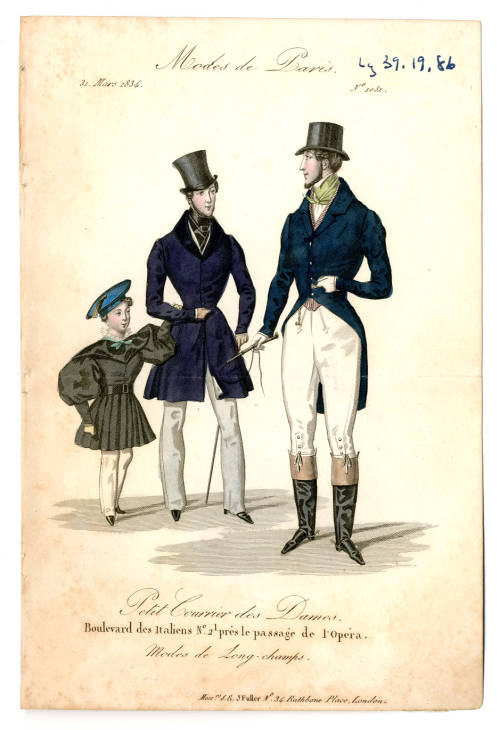
Still not much changed from the previous decade, tall-crowned top hats are the most popular choice for men. They were typically made of Beaver, but could be gray or white in the daytime as well as black, though black alone was worn in the evening. As the decade wore on, silk became more popular, and in 1835, the Gibus hat became popular as a collapsible top hat for evening events.
Resources
- Cunnington, C. Willett. English Women’s Clothing in the Nineteenth Century. Courier Corporation, 2013.
- Franklin, Harper. “1830-1839 | Fashion History Timeline.” Fashion History Timeline. Accessed February 12, 2025. https://fashionhistory.fitnyc.edu/1830-1839/.
- McClellan, Elisabeth. Historic Dress in America, 1800-1870, 1910.
- “Men’s Wear 1830-1849, Plate 017.” Accessed February 12, 2025. https://libmma.contentdm.oclc.org/digital/collection/p15324coll12/id/6747.
- Peacock, John. Costume 1066 To the Present 3e. National Geographic Books, 2006.
- The National Portrait Gallery. “Fashions for July 1838.” Accessed February 12, 2025. https://www.npg.org.uk/collections/search/portrait/mw280911.
- “Women 1830-1831, Plate 065.” Accessed February 12, 2025. https://libmma.contentdm.oclc.org/digital/collection/p15324coll12/id/333.
 Forest Idylls