Anyone who has played The Oregon Trail game knows the dangers of river crossings. How many of us have not lost an axle, supplies, or a “family member” during one of those crossings? Well, that game was probably more accurate than we’d like to think. River crossings were one of the more dangerous and feared activities on the Overland Trail. Typically, you had limited options for crossing a river (or a swollen stream), and often your choice depended on both what was available and what the river was like.
Bridges: Though you don’t often hear of them (since they aren’t as dramatic as the other ways of crossings), there were actually some bridges along the trail, especially in later years. Of course, they were often toll bridges so you had to be prepared to pay, though, based on some of the diary entries I’ve read, it didn’t cost nearly as much as ferrying.

Ferry: Probably one of the most well known methods of crossing rivers, ferries were used especially for deep rivers. Usually comprised of log rafts, ferries could be very expensive. The price fluctuated depending on demand and danger and, although usually safer than fording or swimming across, safety still was not guaranteed. The rafts could tip, or ropes could break, or the ferryman charging outrageous amounts might even be drunk, as indicated in Charlotte Allis’ diary. If there was not a ferry available or the emigrants didn’t want to pay, they might build one of their own. One thing not often mentioned is how long travelers sometimes had to wait their turn, though. It was not uncommon to have to camp several miles away because the line was so long and one diary entry mentions waiting from a Saturday to a Tuesday for their turn to cross. See below for an interesting account of ferrying:
” We crossed Bear River last week on a little raft of nine small logs. There is always a ferry there in the season. But as we were very early in leaving the valley, we arrived there before the ferryman and not bin willing to wait his arrival some agreed to procure logs from the mountains and build a raft which was just large enough to take on one wagon at a time. There were between 20 and 30 crossed in this way…I met with a trifling accident in crossing. When our wagon was put on the raft it was thought I might as well go over at the same time, not inside, as that was not safe so I was told to stand by the hind wheel. Sarah was in my arms, the raft was let loose from shore and owing to the wagon not being pushed far enough on it backed of into the water, sending the raft and some portion of my legs underwater. I was much scared as the jerk had made sis fall back over my arm. I thought my child was gone. I screamed. O my child. But William, who was on with me threw his arms round my back and caught her and held us both tight in his arms to the wheel until they pulled us back to shore.”
Holmes and Duniway, Covered Wagon Women: 1852, The California Trail, 287.
Float: If there wasn’t a ferry available, or the emigrants didn’t want to pay the toll, or they simply decided this was the best way to cross, the wagons could be floated across. Which basically means that the emigrant would take the wagon apart. Yup. So, remove the top and the wheels, leaving you with the bed of the wagon, and then seal it – common waterproofing methods might be covering it with tar or candle wax mixed with ashes, or with buffalo hides. Put all your belongings (and the other parts of the wagon) into it, and row across the river. There’s an interesting portrayal of how this was done on YouTube at minute 12:50.
Ford: And, finally, there is fording. This is basically just walking/swimming your wagon across the river and hoping for the best. If the river was low and gentle, this was a common method, but it wasn’t guaranteed to be a success. There was always the possibility the sandbar your oxen was crossing could give way into deeper water that they weren’t expecting, or that they would stumble or get stuck in the bottom of the river. It also often required a lot of work as the travelers tried to put their goods up high to avoid them getting wet, sometimes raising the wagon beds by a foot or more, and often, of course, calking or waterproofing the wagon bed to try and prevent water from seeping in.
What about the animals? Excellent question. While the animals could also be ferried across the river, it was quite expensive to do so. Therefore, no matter which method the emigrants chose, livestock was most commonly required to swim across the river. This meant a couple of men had to lead them into the river and direct them across and, sadly, it was not uncommon to lose many animals (and men) this way.
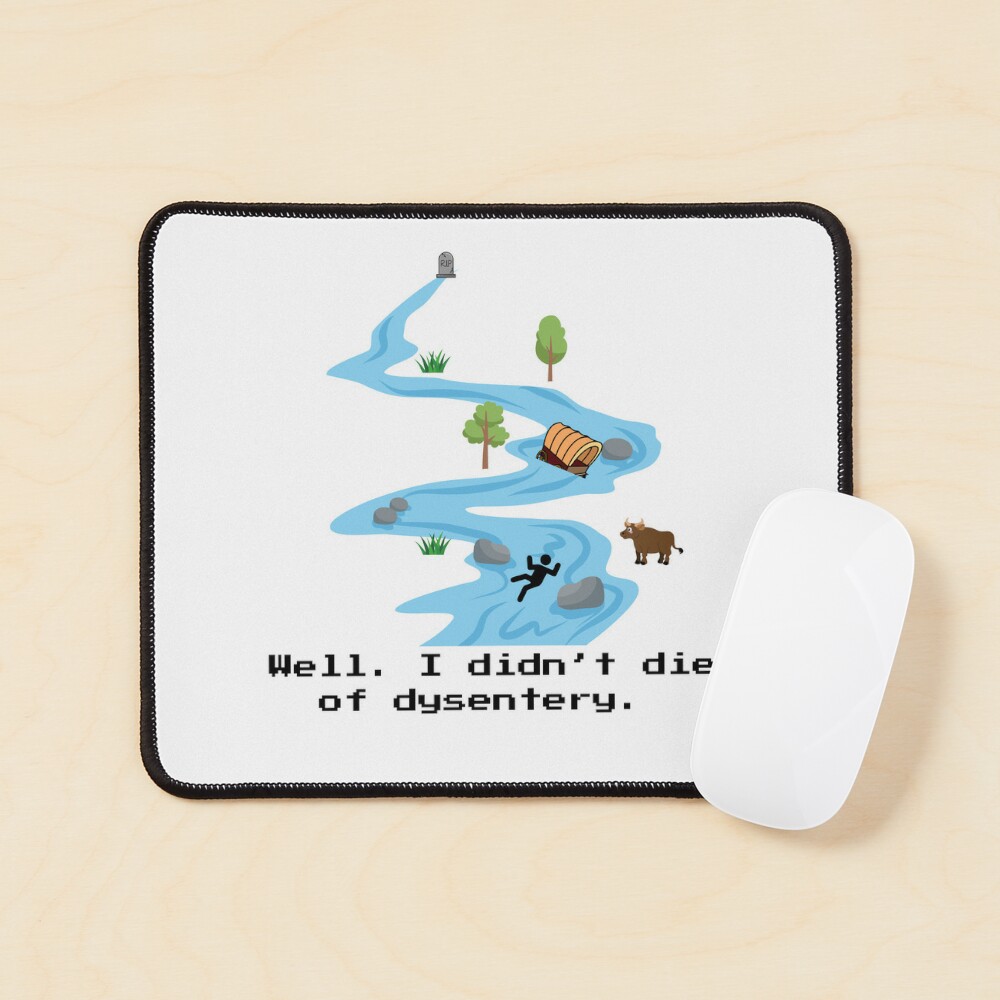
And there you have it! Now you know that you are far more likely to die of a river crossing than you are of dysentery.
Resources
- Assmann, Cody. “Oregon Trail River Crossings — Frontier Life.” Frontier Life, November 17, 2023. https://www.frontierlife.net/blog/2020/6/9/oregon-trail-river-crossings.
- “Hardships.” Accessed January 22, 2025. http://oregontrail101.com/hardships.html.
- Holmes, Kenneth L., and David Duniway. Covered Wagon Women: 1852, The California Trail. U of Nebraska Press, 1995.
- Holmes, Kenneth L., and Shirley A. Leckie. Covered Wagon Women: 1854-1860. U of Nebraska Press, 1998.
- Wyoming Historical Society. “Crossing the North Platte River | WyoHistory.Org.” Accessed January 22, 2025. https://www.wyohistory.org/encyclopedia/crossing-north-platte-river.
- Wyoming Historical Society. “Lombard Ferry on the Green River | WyoHistory.Org.” Accessed January 22, 2025. https://www.wyohistory.org/encyclopedia/lombard-ferry-green-river.
- “You Have Died of Dysentery: The Oregon Trail Game.” Accessed January 22, 2025. https://www.died-of-dysentery.com/stories/crossing-rivers.html.
- Years of personal research
 Forest Idylls