And enter the era of flowers and ribbons! Bonnets, hats of various kinds (but particularly leghorn), and turbans were all popular during this decade, with the size of the hats growing so large by the end of the decade that Cunnington mentions animals in the streets would shy away from them!
Quick Overview
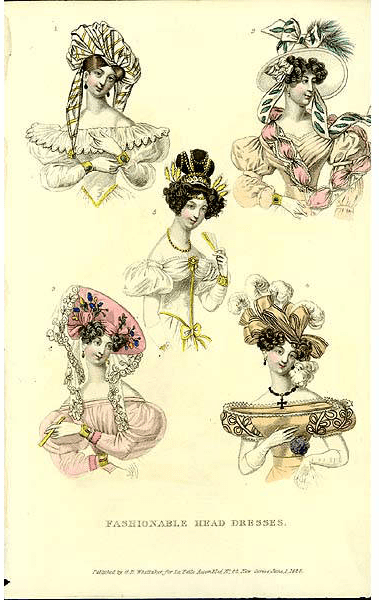
- While bonnets, hats, and turbans took center stage, it was not necessarily uncommon to still see mob caps, particularly at home.
- Flowers, particularly roses, covered everything! Many hats had a veritable bouquet of different flowers.
- Most hats and bonnets were trimmed with ribbons, often extremely broad, with strands trailing untied over the shoulders.
- Lilac and rose seemed to be particularly popular hat/bonnet colors, though white, green, and other colors are certainly mentioned.
- Feathers had not disappeared! Whether combined with ribbons and flowers or on their own, there were plenty of hats with plumes.
More Details
- Hats and Bonnets: Bonnets and hats both were typically placed far back on the head during this decade, particularly further along in the decade, leaving plenty of space in the front for decoration! flowers, feathers, bows, ribbons, and even things like ears of corn (Cunnington, English Women’s Clothing in the Nineteenth Century.). They were commonly made of silk, satin, or velvet, or, mentioned quite often, leghorn – a versatile, straw bonnet. They were decorated with flowers of every size and shape, though roses are most frequently talked about, as well as wide ribbons, bows, feathers, greenery/vegetation, or things like ears of corn! Alternatively, sometimes they were trimmed with lace, gauze, or, for bonnets, even made of gauze. Both often had lace or silk cornettes underneath and/or were lined with silk. It was common to leave the ribbons hanging loose down the sides rather than tying them.
- Example: “Park carriage bonnet of white crape over white satin, lined with a fluting of broad blond; the crown finished by a light gauze puffing, with a leaf end richly trimmed with blond. On the left side, a full bunch of provence roses, surmounted by a marabout plume of feathers.” (McClellan, Historic Dress in America, 1800-1870, 157.)
- Turbans: Surprisingly still fairly popular, turbans were often worn in the evening and commonly decorated with feathers. They were made of many different materials, including crepe and gauze, and sometimes had veils.
- Example: “Turbans richly embroidered, and fastened with gold brooches, are much worn by young married ladies; they are surmounted either by marabouts, esprits, heron’s feathers, bird of paradise plumes, or curled ostrich feathers. A long veil is often worn with a turban, the veil floating behind a la Reine.” (McClellan, 151.)
- Evening: As mentioned previously, turbans could be worn in the evenings, but in addition, it was popular to wear simpler headdresses, such as bandeaus of pearls, flowers, or roses. A girl might wear a wreath made of silver leaves, or keep it as simple as roses on one side of her curls. Berets are mentioned a couple of times, made of gauze and decorated with ribbon, as well as toques (broadly defined as a brimless hat).
- Example: “Vienna toque of separate stiffened puffs of pink satin with short white curled feathers. One long loop of pink gauze ribbon depends over the left shoulder.” (Cunnington, 93.)
Men’s Hats
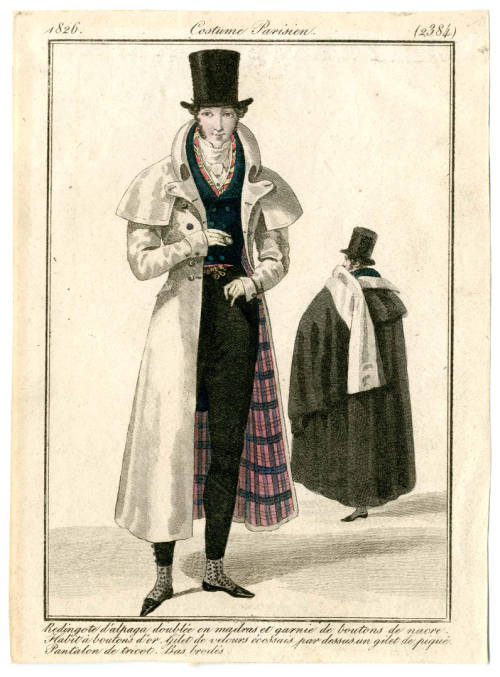
Very little changed from the previous decade, with top hats still being the most popular choice for men. Tall, the only change is being wider at the top and narrower at the crown, and one source mentioned shallow, curled brims as well.

Resources
- Cunnington, C. Willett. English Women’s Clothing in the Nineteenth Century. Courier Corporation, 2013.
- Franklin, Harper. “1820-1829 | Fashion History Timeline.” Fashion History Timeline, n.d. https://fashionhistory.fitnyc.edu/1820-1829/.
- Greenberg, Hope. “Exploring the Austen-Era Toque,” June 2022. https://www.uvm.edu/~hag/2022-jasp-toque-history-catalog.pdf.
- “Hats and Hair Fashions, 1828,” n.d. https://digitalcollections.lib.washington.edu/digital/collection/costumehist/id/416/rec/20.
- “Hats and Hair Fashions, 1828,” n.d. https://digitalcollections.lib.washington.edu/digital/collection/costumehist/id/416/rec/20.
- McClellan, Elisabeth. Historic Dress in America, 1800-1870, 1910.
- “Men’s Wear 1790-1829, Plate 008,” n.d. https://libmma.contentdm.oclc.org/digital/collection/p15324coll12/id/2445.
- Peacock, John. Costume 1066 To the Present 3e. National Geographic Books, 2006.
 Forest Idylls
All I can think of is the song from Hello Dolly:
“I’ll be wearing ribbons down my back, this summer! Blue and green and streaming in the yellow sky…”
Love this! Thanks for sharing!
LOL – that’s perfect!