Can anyone say FEATHERS? Apparently the regency era was also the era of all the feathers. It is one of the few consistent things in this decade. While not quite as varied as the previous decade…it is pretty close.
Quick Overview
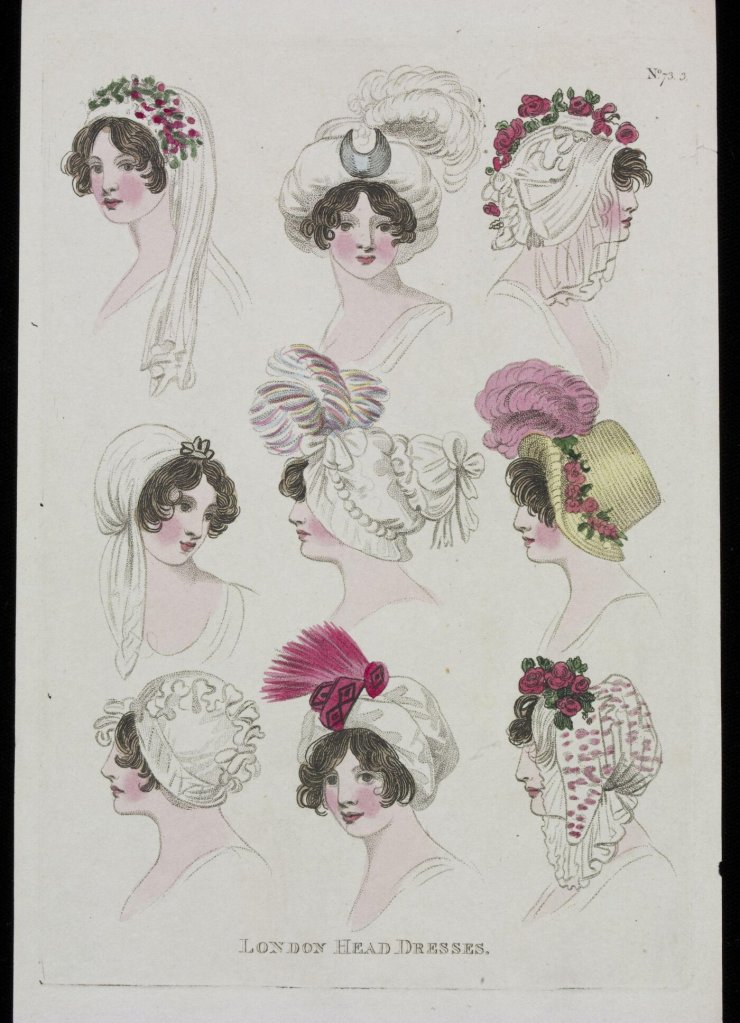
- Feathers over everything!
- Marie Stuart shaped hats
- Hat styles named after various people
- Bonnets of various styles
- Evening: Caps, turbans, and headdresses for matrons
- Evening: pearls or flowers in hair for young women
- Caps, significant variety, but lace ones often under hats
- Some cornettes
More Details
- Marie Stuart: The Marie Stuart style was brought up fairly frequently and therefore seems to deserve its own explanation. Cunnington’s book in particular talks about the Marie Stuart cap of cloth, Marie Stuart shaped bonnet, Marie Stuart shaped cornette, Marie Stuart shaped walking bonnets. So what was the Marie Stuart shape? In essence, it was a heart shape when viewed from the front. So slightly protruding on the sides and coming down to a slight point in front. I would offer a picture of it, but this blog post from Anna Worden gives lots of examples as well as going into far more depth: If I Had My Own Blue Box
- Bonnets: The number of different bonnet types is astonishing. One can imagine almost any manner of bonnet, and would likely be correct. Oldenburg, cottage, Princess Caroline, Poke, Netherland, Mourning, Walking, Angouleme, French, and Leghorn are many of the types named in fashion books, and far too numerous to go into details for each one. The bonnets were usually trimmed with feathers and ribbons, often with an ostrich plume. Indeed, more than one source said that no lady was seen without her plume, one of which clarified, “My headdress was surmounted by the obligatory plume….[made] of only seven enormous feathers, the smallest number allowed. Plumes of moderate size were composed of twelve or fifteen feathers, and in some cases of as many as twenty-five” (McClellan, Historic Dress in America, 1800-1870.). Most trimmings were in bright colors and it was not unusual to have lace over the edges of the bonnet. While many brims were wider than before, there were certainly shorter or turned up brims as well.
- Example: (1811) “…a new bonnet made of India muslin with a cone-shaped crown and trimmed with a bow of lace on the top, around the face a deep frill of Mechlin lace, and the bonnet lined throughout with a bright sea-green sarsnet.” (McClellan, Historic Dress in America, 1800-1870, 95)
- Caps: As mentioned in my previous post, cap seems almost to describe a variety of hats, as references include satin caps turned up in front, dress caps, caps shaped like a turban, etc. As is often the case, there are some opposing opinions. One source mentioned that lace caps were commonly used for full dress, while another says that caps were typically only worn by matrons. Technically, both could be true, and, indeed, it does appear that the young ladies favored simpler hair decorations for the evening. There were also often lace caps worn under bonnets or hats.
- Example: (1813) “Bonnet cap of Jonquille satin and double borders of scalloped lace, confined on one side with ribands of the same color.” (Cunnington, English Women’s Clothing in the Nineteenth Century, 66.)
- Hats: Similar to the bonnets, there were also innumerable names for different types of hats. Just a few included comet, Spanish, Buonapartian, Pamona, riding, village, slouch, crush, etc. One frequently reference is the chip hat, which is apparently a hat made of thin pieces of wood, though the shape varied (“Chip Straw – CandiceHern.Com.”) No matter the type of hat, many were mentioned as having a satin cap beneath it. They were often, just as bonnets were, trimmed in bright colors and made of a large variety of materials, including gauze, velvet, satin, beaver, silk, straw, and, as previously mentioned, wood! The size and shape of the hat was just as varied, with wide brims that were turned up in front, riding hats that looked similar to a man’s top hat, turban shapes, even Cossack hats (described in the example). Whatever the hat, they were commonly decorated with ribbons (riband), lace, feathers, pearls, flowers, and the occasional shell! There could also potentially be cording, tassels, and buckle ornaments.
- Example: “The Cossack hat was also very fashionable; it was made of white satin too, but the shape was a helmet crown and the front, which turned up all round, was sloped a little in the middle, and was edged with pearls; it was finished with a small white feather, place rather to the side.” (McClellan, 105.)
- Evening: While there were certainly hats, such as crush hats, mentioned for evening wear, it was common for young women to wear simpler trimmings such as bandeaus made of pearl or other materials with a plume, or flowers and nets. As mentioned previously, some, especially matrons, might wear caps and while turbans weren’t as popular as before, they were certainly still in use.
- Example: (1818) “Cap of white satin, ornamented with blue satin and ostrich feathers.” (Cunnington, 69.)
While I couldn’t cover all the ways a hat and bonnet might look due to the variety, look through the resources below to find more information, or even do an internet search for the different types of hats I mentioned and find pictures of them!
Men’s Hats
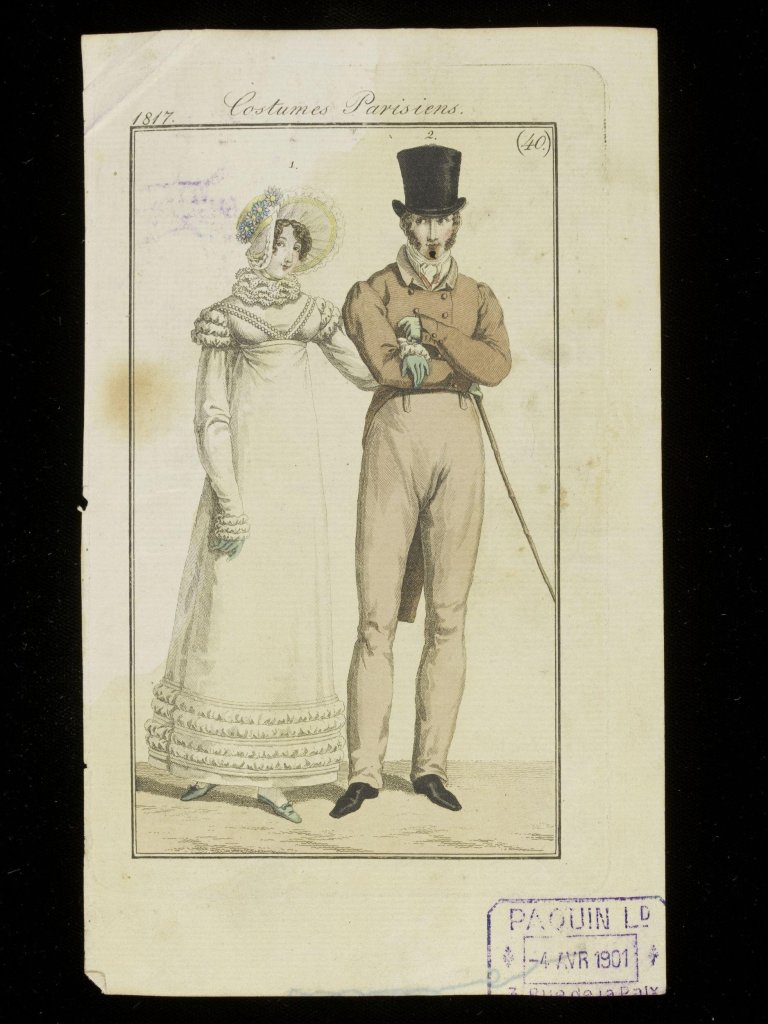
While hats with low crowns and curved brims were seen around this time, top hats still remained quite popular, though the shape began to change as the brims and crowns both narrowed. According to one source, “For evening, the chapeau-bras was a stylish choice, flat and foldable to be carried under the arm.” (Franklin, “1810-1819 | Fashion History Timeline.”)

Resources
- CandiceHern.com. “Chip Straw – CandiceHern.Com,” January 9, 2015. https://candicehern.com/regency-world/glossary/chip-straw/.In-text citation
- Cunnington, C. Willett. English Women’s Clothing in the Nineteenth Century. Courier Corporation, 2013.
- Franklin, Harper. “1810-1819 | Fashion History Timeline.” Fashion History Timeline, n.d. https://fashionhistory.fitnyc.edu/1810-1819/.
- If I Had My Own Blue Box: “Marie Stuart Bonnets,” March 3, 2014. https://annaworden.com/2014/03/02/marie-stuart-bonnets/.
- Knowles, Rachel. “Blog | Regency History.” Regency History, May 10, 2024. https://www.regencyhistory.net/blog/find-ackermanns-repository-regency-history-guide.
- McClellan, Elisabeth. Historic Dress in America, 1800-1870, 1910.
- Museum, Victoria and Albert. “Fashion Plate | Unknown | V&A Explore The Collections.” Victoria and Albert Museum: Explore the Collections, n.d. https://collections.vam.ac.uk/item/O576885/fashion-plate-unknown/.
- Peacock, John. Costume 1066 To the Present 3e. National Geographic Books, 2006. http://books.google.ie/books?id=mtONEAAAQBAJ&dq=costume+1066+to+the+present&hl=&cd=1&source=gbs_api.
- “Women 1800-1819 Part 2, Plate 044,” n.d. https://libmma.contentdm.oclc.org/digital/collection/p15324coll12/id/7209.
 Forest Idylls