If you think you are seeing this post come up for the second time – you are. Somehow the scheduling got mixed up and it posted last week instead of this! But now I’m reposting it on the day it was supposed to come up in the first place. Ahh, the trials of modern convenience.
I started out this research with looking at all my books specifically on hats in my Amazon Wishlist and considering using it as an excuse to buy each and every one of them. But I didn’t. Because, if I’m being honest, between my books and online research I don’t NEED them to make this series. I just want them. But I set that aside for now to concentrate on the resources I do have and I have way more information than I thought I did – thanks to that historical book I found published in 1910 that is all about 19th century clothing! A lot of the information in there was on hats vs dresses, which I think shows how much more important hats were to fashion even in the 1910s than they are today. I have a modern super thick book on historical fashion and they only mention hats once! Anyway, all that to say, there’s a reason there are entire books dedicated to hats. So, I’m going to give the quick overview first for anyone who just wants the big picture, and then go into a little more detail for those who want more!
Quick Overview
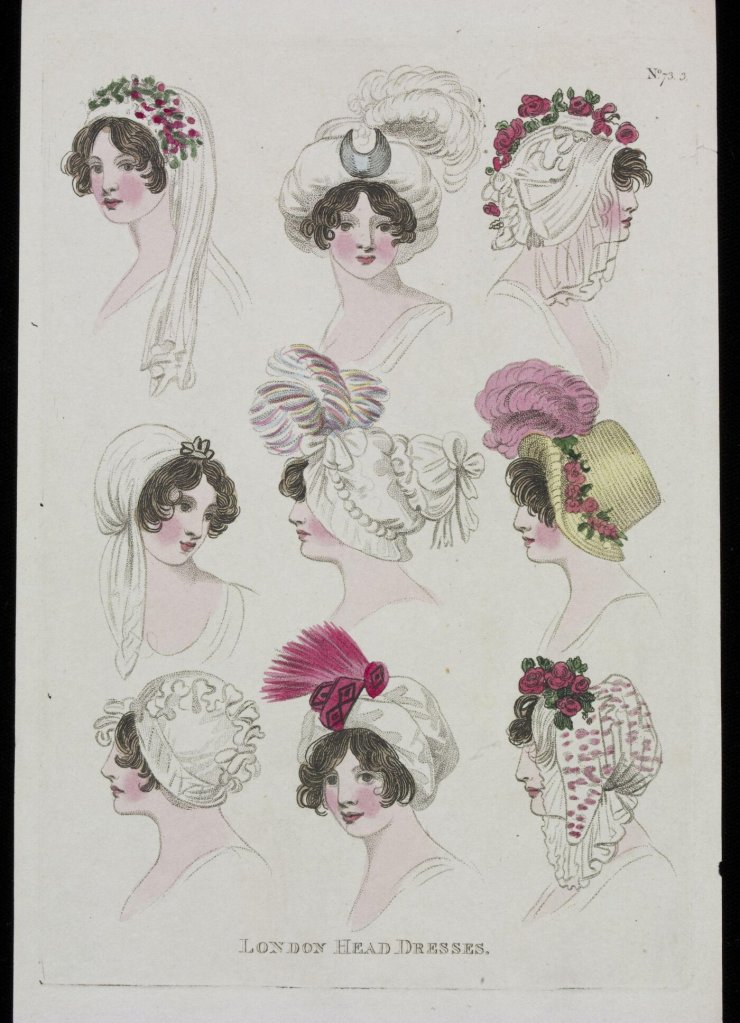
- Variety, variety, variety
- All materials, all shapes, all sizes
- Wigs in the early part
- Turbans
- Veils
- Bonnets
- Straw hats
- Caps
- Ostrich Feathers were popular as an accessory
- Most hats did not conceal the face
More Details
This one is hard to narrow down because so many style were popular! While the mode of dress was simplistic – high waist, clean lines, often white – the hats contrasted significantly with that in their variety of colors, materials, and shapes. But I’ll try to summarize so I don’t just end up writing another book on the subject.
- Wigs: In the early part of the century, wigs were still somewhat common, at least in more fashionable areas. Personal letters show young girls requesting their parents purchase them wigs both because most people wear them and so that they don’t have to do their own hair. In general the wigs (or hairstyles) depicted short, often curly hair.
- Example: “Will you be so good as to send orders to the milliner…for two wigs of the colour of the hair enclosed and of the most fashionable shapes that they may be in Washington when we arrive? They are universally worn, and will relieve us as to the necessity of dressing our own hair, a business in which neither of us are adept.” (a letter from Martha Jefferson Randolph to her father in 1802, courtesy of Historic Dress in America by Elisabeth McClellan, pg 31)
- Turbans: Often worn with short hair and feathers or even veils, full turbans and half turbans were both popular, particularly as evening wear. It could be made of many materials, some of which were white silk, India muslin, velvet.
- Example: “[I]n Figure 33…the head is copied from a contemporary portrait, the loose, soft curls confined by a half-turban of thin muslin, the ends of which are trimmed with lace and tied in a a becoming knot.” (McClellan, Historic Dress in America, 1800-1870, pg 73.)
- Straw Hats: Mentioned many times and in many different formats, straw hats appeared to be a staple during this decade, usually with a larger brim but turned up in front and tied with a ribbon, but sometimes more close-fitting or even in the style of a bonnet or a turban, but made of straw. Was also often decorated with ribbons, flowers, lace, or feathers.
- Example: “A straw hat, turned up before, and lined with blue; blue ostrich feathers in front.” (1801 Festoon of Fashion, courtesy of McClellan, Historic Dress in America, 1800-1870, pg 36.)
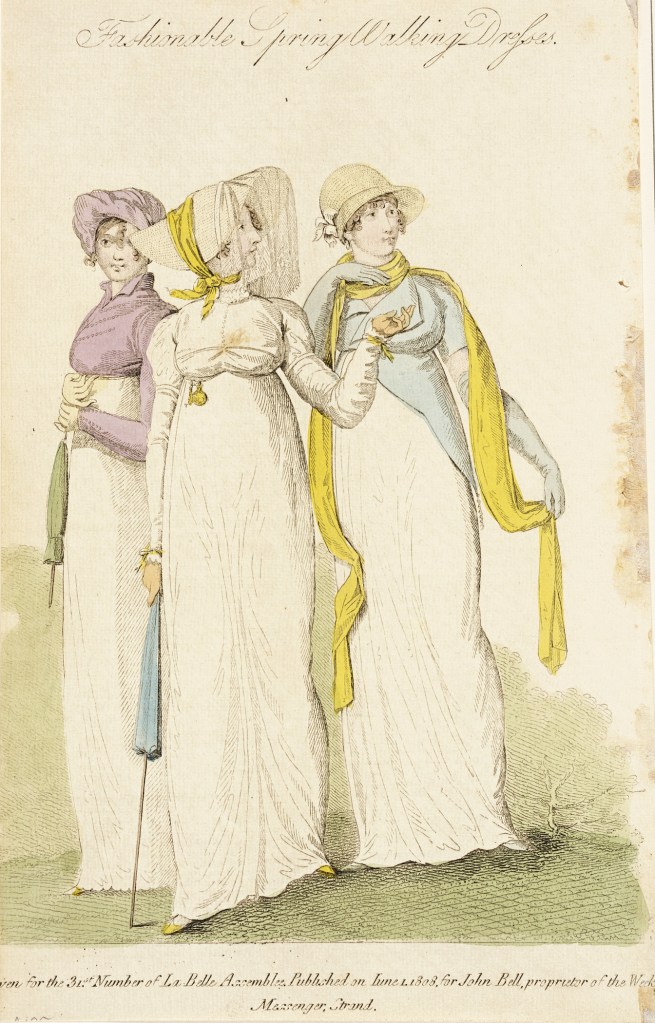
- Bonnets: Coming in all shapes and materials, this was especially popular during the day but there were evening bonnets as well. Trimmed in material, feathers, lace, flowers or anything else one might imagine, it could be made of a variety of materials, such as muslin, straw, velvet, silk, and sometimes was accompanied by a veil hanging down the front or sides. They were often small and close fitting, but the brim seems to vary between be close, wide, or turned up in front.
- Example: “Walking dress…a village bonnet of sarsenet or satin, formed in French flutings in front, ornamented with a full bow of appropriate ribband in the center and tied under the chin with the same.” (1808 La Belle Assemblee, courtesy of McClellan, Historic Dress in America, 1800-1870, pg 74)
- Caps: Like bonnets, these appeared to come in all shapes and sizes and, in my opinion, seems like almost a catch-all for hats that don’t fit one of the other categories. I saw descriptions for caps that included material tied around hair with lace edging, lace open at the top to show off hair and wrapped with ribbon, silk with bunches of roses, muslin with ribbon and a full crown, etc. Essentially it appears that if it wrapped around your hair and was made of some form of usually soft material, it was considered a cap.
- Example: “Evening dress. Cap of white lace with a deep border on one side; band of white satin and bugles round the front; white ostrich feathers.” (Cunnington, English Women’s Clothing in the Nineteenth Century, pg 55.)
- Veils: The fascinating thing about the veils at this time is that it appears once could wear them however one wished. There are pictures of women wearing veils as headdresses, or wearing them down the back of a hat, down the front, or down the sides, or even around the entire hat except the front.
- Example: “Walking dress. Bonnet of purple velvet covered with lace and trimmed with purple ribands; short lace veil.” (Cunnington, English Women’s Clothing in the Nineteenth Century, pg 56.)
There are SO many more details I could go into, but if you want to go that deep, I highly recommend looking into the resources below!
Men’s Hats
There is significantly less information on men’s hats, not surprisingly. But popular hats included beaver or top hats, sometimes made with felt or silk. As the decade moved on the brims drooped more and then became wide with high crowns. Popular evening hats included the bicorn and cocked hats (two and three points), but they were almost exclusively used for evening dress, tucked under an arm.

Resources
- Museum, Victoria and Albert. “London Head Dresses | Unknown | V&A Explore The Collections.” Victoria and Albert Museum: Explore the Collections, n.d. https://collections.vam.ac.uk/item/O568222/london-head-dresses-fashion-plate-unknown/.
- McClellan, Elisabeth. Historic Dress in America, 1800-1870, 1910. http://books.google.ie/books?id=NHNTAAAAMAAJ&q=Historic+Dress+in+America+by+Elisabeth+McClellan&dq=Historic+Dress+in+America+by+Elisabeth+McClellan&hl=&cd=3&source=gbs_api.
- Cunnington, C. Willett. English Women’s Clothing in the Nineteenth Century. Courier Corporation, 2013. http://books.google.ie/books?id=NELDAgAAQBAJ&printsec=frontcover&dq=english+women%27s+clothing+in+the+19th+century&hl=&cd=1&source=gbs_api.
- Peacock, John. Costume 1066 To the Present 3e. National Geographic Books, 2006. http://books.google.ie/books?id=mtONEAAAQBAJ&dq=costume+1066+to+the+present&hl=&cd=1&source=gbs_api.
- “Fashion Plate, ‘Fashionable Spring Walking Dresses’ for ‘La Belle Assemblée’ | LACMA Collections,” n.d. https://collections.lacma.org/node/252620.
- Knowles, Rachel. “Blog | Regency History.” Regency History, May 10, 2024. https://www.regencyhistory.net/blog/find-ackermanns-repository-regency-history-guide.
- Franklin, Harper. “1800-1809 | Fashion History Timeline.” Fashion History Timeline, n.d. https://fashionhistory.fitnyc.edu/1800-1809/.
- “Men’s Wear 1790-1829, Plate 004,” n.d. https://libmma.contentdm.oclc.org/digital/collection/p15324coll12/id/2441/rec/4.
 Forest Idylls
The links seem to be broken – they are not opening everything up for me. Except a page that says the page can’t be found.
Exploring the elegance of 19th-century headwear? Elevate your historical ensemble with the Authentic Bicorn Hat – Classic Military & Pirate Style from Hat and More. Perfect for reenactments, cosplay, or making a bold fashion statement. Discover yours here: hatandmore.com/hats-caps/bicorn-hat.html