There were quite a variety of descriptions on this one, including some conflicting information–such as lots of information on women’s walking boots but also notes saying that day shoes were more fashionable than walking boots, so it seems clear that there was some transition during this time period.
1881-1890ish
Men’s Footwear
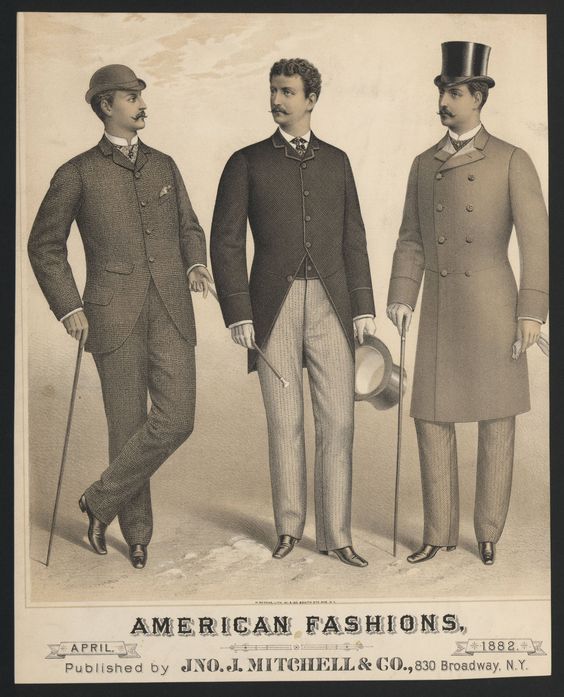
- Narrow, pointed toes or round toes
- Leather ankle boots or shoes with contrasting toe caps
- Low stacked heels
- Possible additions: lace fastenings, elastic side gussets, simulated button fastenings, calfskin uppers
- House slippers
Women’s Footwear
- Walking boots with low or Louis heels
- Low stacked heeled shoes with leather toes
- Possible details: high and/or side buttoned, patent leather, white buckskin, buckles, high vamp, embroidery, laced, ribbon
- Example: Pale-colored doeskin upper with ribbon laces through center front.
- Evening: Pointed toe, low heel, often matched dress
- Possible details: suede, silk, satin, bronze, glazed kid, embroidered with beads or hand-painted, bow on instep

Resources
- Peacock, John. Shoes: The Complete Sourcebook, 2005. https://doi.org/10.1604/9780500512128.
- Peacock, John. Costume 1066 to the Present 3e: A Complete Guide to English Costume Design and History, 2006. https://doi.org/10.1604/9780500286029.
- Cunnington, C. Willett. English Women’s Clothing in the Nineteenth Century. Mineola, New York, United States: Dover, 1990.
- “Women 1883, Plate 047,” n.d. https://libmma.contentdm.oclc.org/digital/collection/p15324coll12/id/7736/rec/47.
- Cushing, Brian. “Victorian Mens Clothing.” Pinterest, January 9, 2015. https://www.pinterest.com/pin/482729653784490372/?lp=true.
 Forest Idylls