In any search regarding the Oregon/California trails, you’ll probably come across the term “Jumping off place” or town or city, or you know, something similar – the key part being “jumping off”. It’s such a commonplace term for anyone looking at the overland trail, that it took me awhile to realize not everyone knew what that meant. So let me simplify it for you:
Towns where emigrants jumped off the Missouri river to start their trip west.
Yup. Basically, this was simply the term for some of the most popular places for wagons trains to leave, and generally, the town offered any and all supplies the emigrants could need, from wagons to oxen to mules to medical supplies to…well, I could keep going, but this post isn’t about preparations.
There were a lot of jumping off towns, but I’ll only touch on the top ones. In essence, however, the jumping off places were all situated along the Missouri River, and it just depended on how far you could get along the river to hopefully shorten the actual wagon journey.
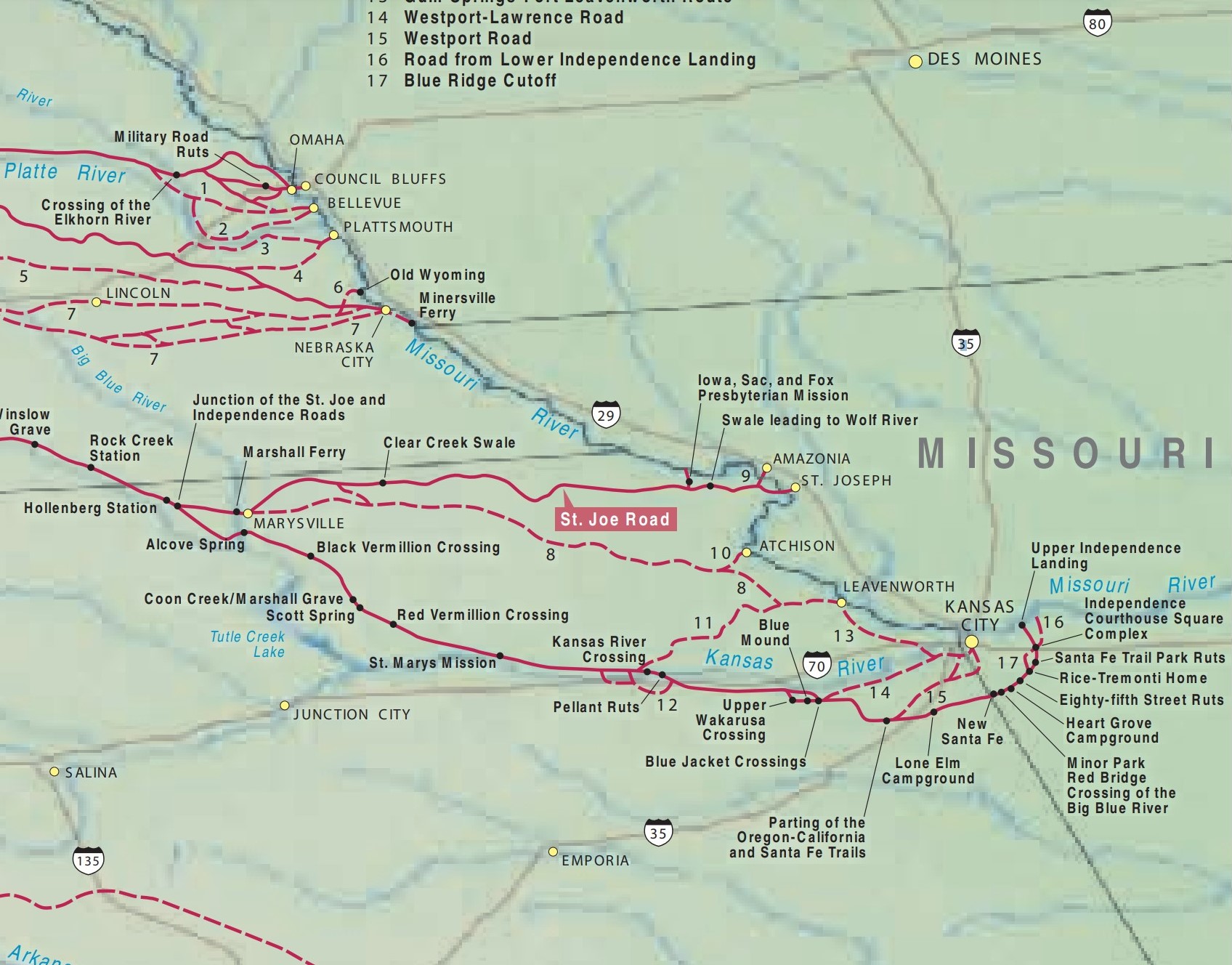
Independence, Missouri

If you know anything about the trails, you have probably heard this name. That’s because it is the most well-known jumping off place, not necessarily because more emigrants left from here, but because it was the first one (you know, kind of like everyone says Oregon Trail but frowns when you try to say California Trail, even though technically way more people took the California Trail. Not that I’m bitter about this terminology gap. Not at all.) It naturally acted as an initial jumping off point because it was the starting place for the Santa Fe trail as well. There were technically two jumping off points from Independence. The first was Upper Independence Landing, also known as Wayne City Landing. The second, despite all my years of research, I haven’t quite figured out. There are references almost everywhere to the Lower Independence Landing, and some places seem to indicate that it is the same as Westport Landing (now known as Kansas City), though Westport is definitely listed as a separate jumping off point from Independence. There are also some references to the lower landing as Blue Mills, which seems more likely than it being the same as Westport. But I’ve included all the references below, so you can draw your own conclusions…and if I get an answer, I’ll try to remember to update you, since I know it will bother you all as much as it does me.

Anyway. Independence was used as a jumping off place mostly through the 1840s (earlier than that as well, but at least according to some sources, the first group of emigrants left from Independence in 1842), but landing places such as Westport quickly grew more popular since you didn’t have to travel quite as long.
St. Joseph, Missouri
”…I COULD NOT BEGIN TO TELL YOU HOW MANY…IN ST. JOSEPH THAT ARE GOING TO OREGON AND CALIFORNIA BUT THOUSANDS OF THEM IT IS A SIGHT TO SEE THE TENTS AND WAGONS ON THE BANKS OF THE RIVER AND THROUGH THE COUNTRY THEY ARE AS THICK AS CAMP MEETING TENTS 20 OR 30 MILES AND SOME SAY FOR 50 MILES…” MAY 6, 1852, MARY COLBY
(Discover St. Joseph History; St. Joseph Gateway Chapter, n.d.)
By the time the 1850s came along, St. Joseph was by far the most used jumping off place, both because it was further along the river and because cholera had broken out in Independence. It also didn’t hurt that there was one less river to cross if you jumped off at St. Joseph. And, indeed, you’ll find that a majority of diaries from the time period head out from St. Joseph.

St. Joseph was, of course, established long before the 1850s, but the gold rush in 1849 solidified it as a go-to jumping off place and throughout the height of the trail years, it was one of the most popular choices with plenty of supplies to choose from and thousands upon thousands of emigrants passing through.
Council Bluffs, Iowa
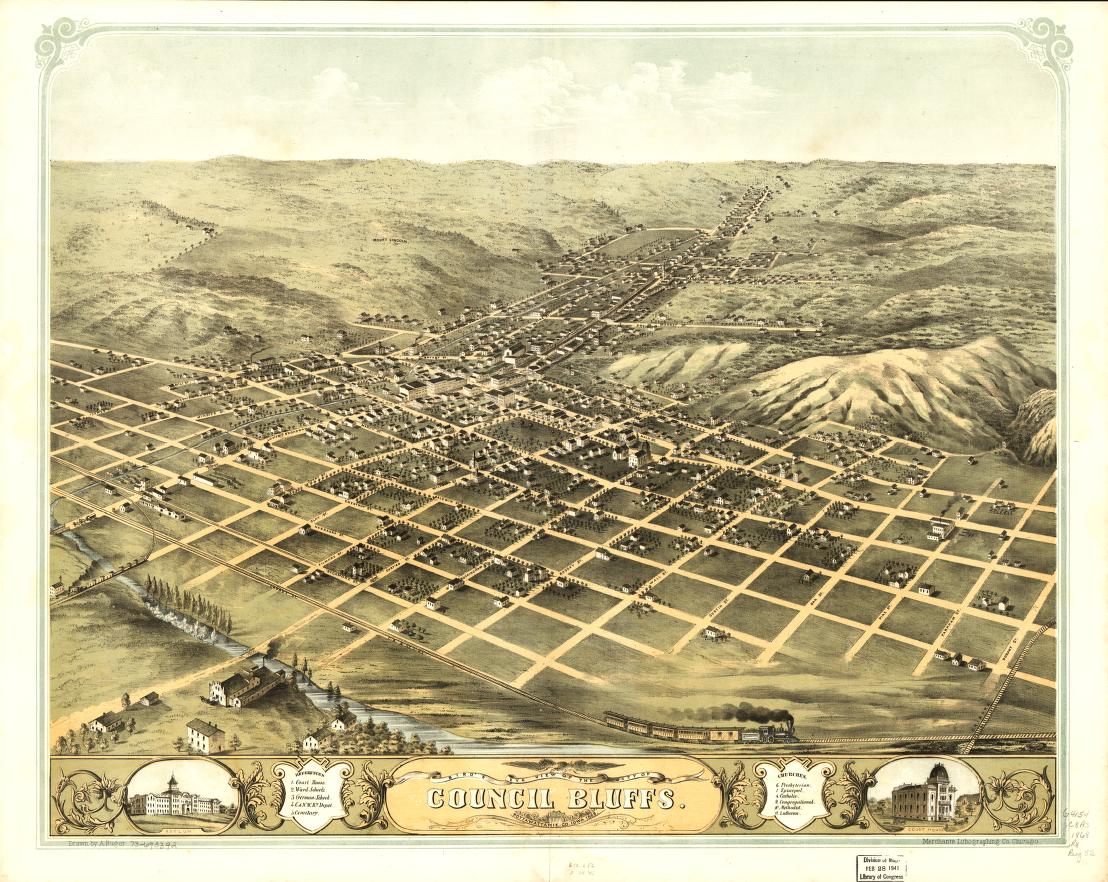
And the last large jumping off spot I’m going to cover is Council Bluffs. Not that there is much to cover. For being one of the main jumping off points, there isn’t a ton of readily available information or numbers for the Overland Trail emigrants themselves. However, it was originally known as Kanesville, after a lawyer who helped the Mormons. Kanesville was the main starting point for the Mormon Trail after they fled their homes due to violence. After the Mormons headed west, the name was changed to Council Bluffs, after the bluffs on which Lewis and Clark gathered in council with some of the Native American tribes.
And there you have it! You finally know what jumping off places are and can talk intelligently about some of the largest! You’re welcome.
Resources:
- The Oregon Trail. “Jumping Off.” Accessed June 21, 2023. http://oregontrail101.com/jumping.html.
- Chapter 2: The Jumping-Off Places – First Impressions (U.S. National Park Service). “Chapter 2: The Jumping-Off Places – First Impressions (U.S. National Park Service),” n.d. https://www.nps.gov/articles/000/chapter-2-the-jumping-off-places-first-impressions.htm.
- Westport, Missouri – Legends of America. “Westport, Missouri – Legends of America,” n.d. https://www.legendsofamerica.com/westport-missouri/.
- Wayne City (Upper Independence) Landing (U.S. National Park Service). “Wayne City (Upper Independence) Landing (U.S. National Park Service),” n.d. https://www.nps.gov/places/000/wayne-city-upper-independence-landing.htm.
- Wayne City Landing, Missouri – Legends of America. “Wayne City Landing, Missouri – Legends of America,” n.d. https://www.legendsofamerica.com/wayne-city-landing-missouri/.
- westporthistorical. “Westport MO History as Gateway to The West,” n.d. https://www.westporthistorical.com/westport-history.
- OCTA. “Origins of the Oregon Trail – OCTA,” n.d. https://octa-trails.org/articles/origins-of-the-oregon-trail/.
- Blue Mills (U.S. National Park Service). “Blue Mills (U.S. National Park Service),” n.d. https://www.nps.gov/places/blue-mills.htm.
- St. Joseph Gateway Chapter. “Discover St. Joseph History; St. Joseph Gateway Chapter.” Accessed June 21, 2023. https://www.gateway-octa.org/trail-history.
- St. Joseph, Missouri – Jumping Off To the West – Legends of America. “St. Joseph, Missouri – Jumping Off To the West – Legends of America,” n.d. https://www.legendsofamerica.com/mo-stjoseph/.
- Kansas Heritage Group. “ST. JOSEPH: 1844 GATEWAY TO OREGON.” Accessed June 21, 2023. http://www.kansasheritage.org/werner/joseph.html.
- Society, Missouri Historical. “‘St. Joseph (Missouri).’” The Missouri Historical Society is … Missouri Historical Society and was founded in 1866., n.d. https://mohistory.org/collections/item/N45779.
- Our History | Council Bluffs, IA – Official Website. “Our History | Council Bluffs, IA – Official Website,” n.d. https://www.councilbluffs-ia.gov/2125/Our-History.
- The Council Bluffs Public Library | Council Bluffs, Iowa. “Why Council Bluffs? Part Two: Kanesville.” Accessed June 21, 2023. https://archive.councilbluffslibrary.org/files/original/fcb0a8659d0e517286d87664aef8c63c.pdf.
- National Park Service. “CHALLENGES OF THE TRAIL.” Accessed June 21, 2023. https://www.nps.gov/parkhistory/online_books/knudsen/sec1.htm.
- Lewis and Clark Monument – Lewis and Clark Monument Park | Council Bluffs, IA – Official Website. “Lewis and Clark Monument – Lewis and Clark Monument Park | Council Bluffs, IA – Official Website,” n.d. https://www.councilbluffs-ia.gov/2306/Lewis-and-Clark-Monument.
- History & Culture – Mormon Pioneer National Historic Trail (U.S. National Park Service). “History & Culture – Mormon Pioneer National Historic Trail (U.S. National Park Service),” n.d. https://www.nps.gov/mopi/learn/historyculture/index.htm.
- The Library of Congress. “Bird’s Eye View of the City of Council Bluffs, Pottawattamie Co., Iowa 1868.,” January 1, 1868. https://www.loc.gov/item/73693392/.
- Moeller, Bill, and Jan Moeller. The Oregon Trail: A Photographic Journey, 2001. https://doi.org/10.1604/9780878424429.
 Forest Idylls
Thank you for explaining the meaning of this term.
I hope it was helpful! Or at least enjoyable. 🙂
i love it was good
good story